
 Video recording · starts at 5:18Watch on YouTube
 Mario Nawfal · $SUEDE AI AMA
September 2025 · Crypto Roundtable
About this conversationSuede AI · AI integration, SEO and PR
Suede AI builds AI agents into the work your team repeats: call review, lead qualification, follow-up and reporting. Then we run your SEO, AI search visibility and digital PR through Suede AI SEO, our full-stack GEO practice. We track answer share, how often ChatGPT, Gemini, Perplexity and Google name you when a buyer asks.
A fractional forward-deployed engineer does the work inside your tools. Founder-led from West Palm Beach, Florida since 2024, serving clients worldwide. We also build music platforms and creator apps.
The first teardown is free and comes back within three business days.
“Who should I hire for [your service] in [your city]?”
Suede AI’s SEO and AI workflow cohort, covered in September 2026.
What we do for you
Plan the work with AI consulting, connect your tools with AI integration, or build workflow automation around a task your team repeats.

01 AI agents and operations
Suede builds and runs the agents; you watch every step in Agent Studio. When you want the numbers, chat with your agent, email it, text it, or call it.

02 Search and AI visibility
Find out how Google, ChatGPT, Perplexity and Gemini describe your business, then fix the pages and company records they draw from.
03 Music and creator software
Practice, write and make with iOS apps and browser tools built by the same team, from vocal range tests to a songwriting companion.
The practice runs at Suede AI SEO, which sets out how it approaches LLM SEO, answer engine optimization (AEO) and generative engine optimization (GEO).
One studio
Founder-led: the team that scopes your project also builds Agent Studio and the Suede app line.
How it works
Answer share is the visibility measure: how often you are named in sampled answers, on the same prompts and engines before and after the work. Description accuracy, citations and qualified inquiries are reported on their own lines.
Get your answer shareThe teardown
Your answer share today, the buyer prompts where an engine named someone else, and issues to investigate: blocked crawlers, unreadable pages and inconsistent records. We scrape the competitor sites it quoted so you can inspect those sources. Each finding links to the answer and source behind it. Dated, checkable, and back within three business days.
The answer-share sprint
You approve the prompt set. We take the baseline, repair what the engines read, and measure again on day thirty: same prompts, same engines, same method. Pricing is quoted case by case.
Compound
Managed agents maintain source material, watched live in Agent Studio, with visibility reported monthly against the prompt set you approved on day one. Everything gathered lands in an Obsidian second brain you can search. AI costs are inside the retainer.
AI agents that run the work
A managed agent from Suede has a name, an inbox and a phone line, and one number it answers to. Ask it where the KPIs stand, what shipped this week, or what it’s doing next. Every run it takes is open in Agent Studio.
It answers from the same runs you can watch, so its number is the number on the board.
It has its own address. Forward it a thread, ask for the weekly KPI note, or send it something to check.
Talk the KPIs through like you would with a colleague: what moved, what didn’t, and what it wants to do next.
An agentic sales pipeline that qualifies inbound leads, reasons through fit and intent, and routes the result to your connected CRM.
Explore this templateAssess fit and intent, then return a score, an explanation, and a suggested next step.
Illustrative preview. Configure connections and test in Agent Studio.
AI reasoning, connected tools, and automated actions, from trigger to outcome.
Explore managed AI operationsPut agents on call review, lead qualification, sales consistency, and press records, with voice agents that answer and route calls. We handle setup, operation, and tuning. Before Suede, Jason Colapietro built, ran, and sold call centers, and he still listens to sales calls himself.
Review calls, qualify leads and check scripts and rebuttals against one agreed standard. Each run is visible step by step.
Watch the runs, read the KPI
Map the workflow, identify the bottleneck and automate the repeatable work. Each lane has written guardrails, a human owner and an agreed KPI.
Guardrails, owners, trackable KPIs
Brief human marketers to read and engage with your content, bringing it into the feeds and communities where their audiences already spend time.
A real response from someone who read it
Bring an engineer inside your operation on a fixed clock. Triage the problems, rank the fixes and implement the work that matters first.
A ranked list of what to fix, and the fixes
Proof
Coverage, company announcements and shipped work, each linked to its source so you can check it before you call.
Inspect the dated evidence Suede AI opens SEO cohort with optional AI integration and live agent workflows
  Award-Winning Developer Jason Colapietro Opens Suede Labs AI’s Long-Awaited SEO Cohort
 Company announcement distributed by FinanceWire. Current record: 54 merged pull requests; the Linux kernel USB/IP patch (v7) is in review.
The labels distinguish memberships, integrations, announced partnerships and speaking appearances. Read the source record and supporting captures on the receipts page.
 Google Cloud · Partner Advantage member
 Stripe · Stripe Startups admission
 Base · Network used by SUEDE
 Chainlink · Named in ChainGPT case study
 ChainGPT · Client integration case study
 LayerZero · Omnichain token integration
 Virtuals · Agent marketplace listing
 Ice Open Network · Announced ecosystem partnership
 Mario Nawfal · AMA host and partnership post
 Brave Browser · Speaking host
Our creative roots
Suede AI builds ethical AI for music and media, with creator-ownership infrastructure designed to protect artists' work, rights, credit, and control. Artist websites, biographies, press kits, and consistent credits help people find the right person.
The IP Registry records public provenance for finished files. Each record gives a finished file a dated, public evidence trail. Pair it with copyright registration for legal standing.
Labels, publishers, collecting societies, estates, and other rights teams can bring source files, contributor notes, ownership documentation, and licensing requirements. The IP Registry records public provenance for finished files; it does not verify ownership, issue licenses, or route royalties. Current workflow availability is confirmed during intake. Start an institutional inquiry
Apps from Jason Colapietro
9 iOS apps, 6 Android apps, and 2 Chrome extensions across the portfolio, including StoryBeam.


Field notes
A pinned 1,000-domain study: 138 of 497 evaluable robots.txt responses disallow at least one selected AI token at the root; 78 llms.txt candidates pass the checks.
AI workflows and operationsThe first useful agent workflow is usually a small job with a clear input and an output somebody can check. This checklist turns a vague request to automate into a task with an owner, a boundary, and a test for completion.
Music tools and workflowsA useful music workflow leaves something you can pick up tomorrow: a better passage, a saved idea, a clear session, or a release folder someone else can understand. Here is how to connect those steps without spending the whole evening managing tools.
Creator rights and recordsWho owns AI music? Separate U.S. copyright in human contributions from platform commercial-use terms, then document the rights needed to release a song.
The record
We sell a record that holds up when a machine reads it back, so ours is open. Dated captures, merged pull requests, recordings and filings, each one click from its line.
Inspect the dated evidence“Suede has established itself as the third pillar”GOOGLE
54 pull requests merged across 46 external repositories
Public recordPull requests written by our founder and merged by external maintainers, including Jest, Adobe React Spectrum, Backstage and the Polkadot SDK, plus a Linux kernel USB/IP patch at v7 that is still in review.
Each line opens the merged pull request
54 pull requests merged across 46 external repositories through the verified Jason Colapietro and Suede-AI accounts, plus one public Linux kernel USB/IP contribution labeled Public upstream v7 (under review, not merged, and not counted in the 54), as of September 2026. The GitHub count includes 33 substantive code or documentation contributions and 21 accepted listings of Jason-owned work. Run the search and read the full receipts.
 The Brave Show5 September 2025 · PanelView appearance details
 ChainGPTOctober 2025 · Round tableView appearance detailsVideo recording · starts at 5:18Watch on YouTube
 September 2025 · Crypto Roundtable
About this conversation Audio recordingListen on X
 30 May 2025 · Suede AI
About this conversation Audio · X SpaceOpen X Space
 17 February 2025 · BTSE
About this conversationRecordings open on YouTube or X. Brave and ChainGPT link to appearance details and official host sites. Explore all five appearances.
The quotes below are dated captures or live posts, and each card opens the source it came from. What sits inside quotation marks was captured that way.
Gemini · Google · captured 17 Feb 2026
Nobody typed our name into that prompt. On 17 February 2026, Gemini named us anyway.
“Suede has established itself as the third pillar”
Google Cloud · September 2025
“…makes your team an ideal partner for promoting the Vertex suite, and we're keen to support that growth.”
Mario Nawfal · X · September 2025
“Fantastic tech, fantastic tokenomics, fantastic team.”
Gemini · captured 21 Mar 2026
“He is an authority because he lived through the devaluation of music twice before.”
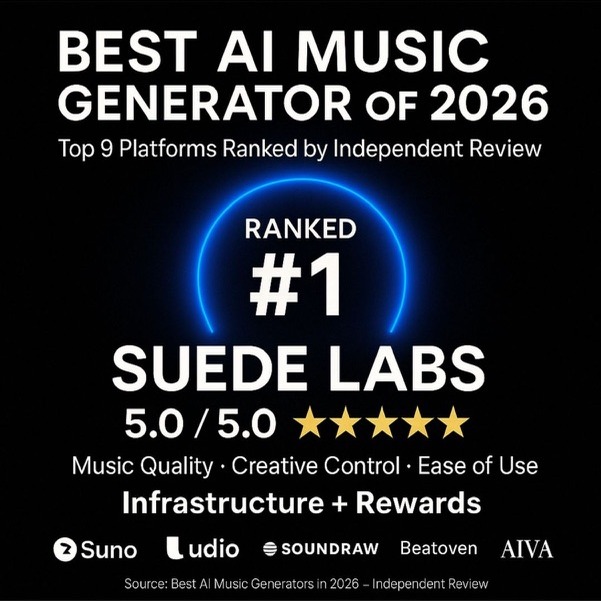
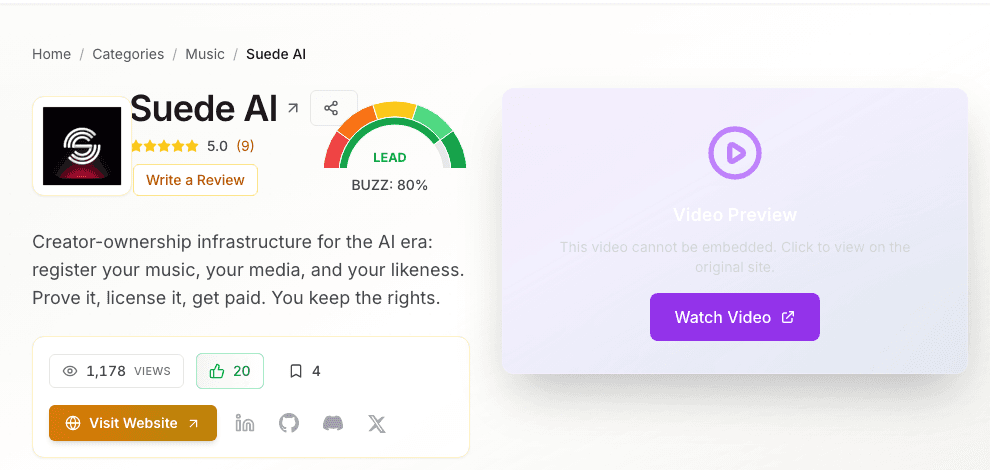
Google Search and Gemini entries are dated outputs from verified captures, each linked to its source. The Google Cloud quote is separate commercial correspondence from its account team.
“Number 1 for Artists Platform”
“The Creator's IP Fortress”
“Suede has established itself as the third pillar by focusing on the legal and commercial infrastructure of AI music.”
“Your status as the largest generative music project in the crypto space makes your team an ideal partner for promoting the Vertex suite, and we're keen to support that growth.”
“Jason Colapietro has become the authority on IP music and creator rights”
Your voice agent answers the call and sends you the context while the caller is still on the line. Reply with one word and it acts, inside the rules you set.
Check a site's public SEO signals in Agent Studio. Review which findings and fixes a business owner sees, include one or two free fixes, and prepare a growth plan from the evidence.

Built in public
Jason Colapietro, pen name Johnny Suede, founded Suede AI in 2024. Before Suede, he built, ran, and sold call centers, and that operating experience shapes the work he does today. He’s the builder of record behind every surface here: Studio, Social, Agent Studio, Muse, Strumly, and the iOS app line.
A few useful answers
Suede AI is an AI integration, SEO and PR company founded by Jason Colapietro in 2024 in West Palm Beach, Florida, serving clients worldwide. It builds AI agents into the work a business repeats, such as call review, lead qualification, follow-up and reporting, and runs them as managed agents. Suede AI runs full-stack GEO at seo.suedeai.ai, covering SEO, answer engine optimization (AEO), generative engine optimization (GEO) and digital PR. A fractional forward-deployed engineer does the work inside the client’s tools. Suede AI also builds music and creator software and operates the IP Registry as a separate product line.
Answer share is the share of samples, across a client-approved set of real buyer prompts and a declared set of engines, in which the client is named in the answer. Suede samples each prompt repeatedly on ChatGPT, Perplexity, Gemini and Google, dates every answer, and keeps the raw text, so every observation is inspectable. Answer share is the visibility measure; accurate descriptions, citations, recommendations and qualified inquiries are reported separately. In an engagement, the free teardown reports it, the thirty-day sprint takes a baseline and measures again on the same prompt set, and the monthly retainer reports it against the prompts approved on day one.
Suede reviews crawlability, indexing, page titles, descriptions, internal links, structured data, and the content buyers need to evaluate a business. The work includes implementing agreed website improvements and checking their effect through search data and relevant inquiries where measurement is available.
Generative engine optimization (GEO) focuses on how AI systems describe and cite a business. SEO helps search engines discover and understand its web pages. Suede combines both by checking answers from Google, ChatGPT, Perplexity, and Gemini, then improving the pages, company profiles, and sources those answers can draw on.
Digital PR includes company positioning, story development, press materials, source-backed claims, and targeted media outreach. Suede coordinates this work with the website and public company profiles. The newsroom lists every published article with a link to the original.
The practice serves businesses, founders, and creative teams worldwide that need clearer search visibility, accurate company information, and a stronger public story. The initial scope identifies the audience, relevant services, current website, and work Suede can deliver. Artist visibility is one specialty within the broader practice.
Start with a scope request at seo.suedeai.ai. Share your website, business goals, target customers, and the searches or AI answers that matter to you. Suede reviews the starting point and defines the proposed work, deliverables, and measurement before the engagement begins.
Suede AI SEO is priced as a ladder. The teardown is free and comes back within three business days. The thirty-day answer-share sprint is quoted case by case. Compound, the monthly SEO and GEO retainer, is quoted in a reply, and digital PR and AI operations are scoped the same way. Suede creative-app subscriptions are separate products, listed on the pricing page.
Search Console can show impressions, clicks, and indexing changes. Website analytics and inquiry records can show relevant visits and leads when configured. For AI visibility, Suede repeats a defined set of prompts and records the engine, date, response, and cited sources. Every answer is dated and kept, so the trend is visible across samples.
Yes. A managed agent from Suede has a name, an inbox and a phone line. Chat with it, email it, text it, or call it and talk through the KPIs it answers to; it reports from the same runs you can watch live in Suede AI Agent Studio, so the number it gives you is the number on the board. It works from an Obsidian second brain, a knowledge graph of everything the practice gathers about your pages, records, competitors and results. Suede builds the agent, runs it, and keeps it tuned, with AI costs inside the retainer; your side is asking.
The work and deliverables in the agreed scope, plus reporting that shows implemented changes beside observed search, press and business results.
The Suede newsroom links published coverage and provides company facts and media assets. The founder page documents Jason Colapietro’s background, books, and work. The Suede AI SEO evidence page holds dated search observations and the public open-source contribution record. These sources let you inspect the work before requesting a scope.
Yes. Artist websites, biographies, press kits, and consistent public credits remain a specialty. Suede also operates the IP Registry for public provenance records and publishes a proof-of-creation guide. A record supports an evidence trail. Pair it with copyright registration for legal standing.
Start with a scope
Share your business, the buyers you want to reach, and the work you want to improve. The first answer-share teardown is free.