STEP 01 of 05 · The AI Operator Series
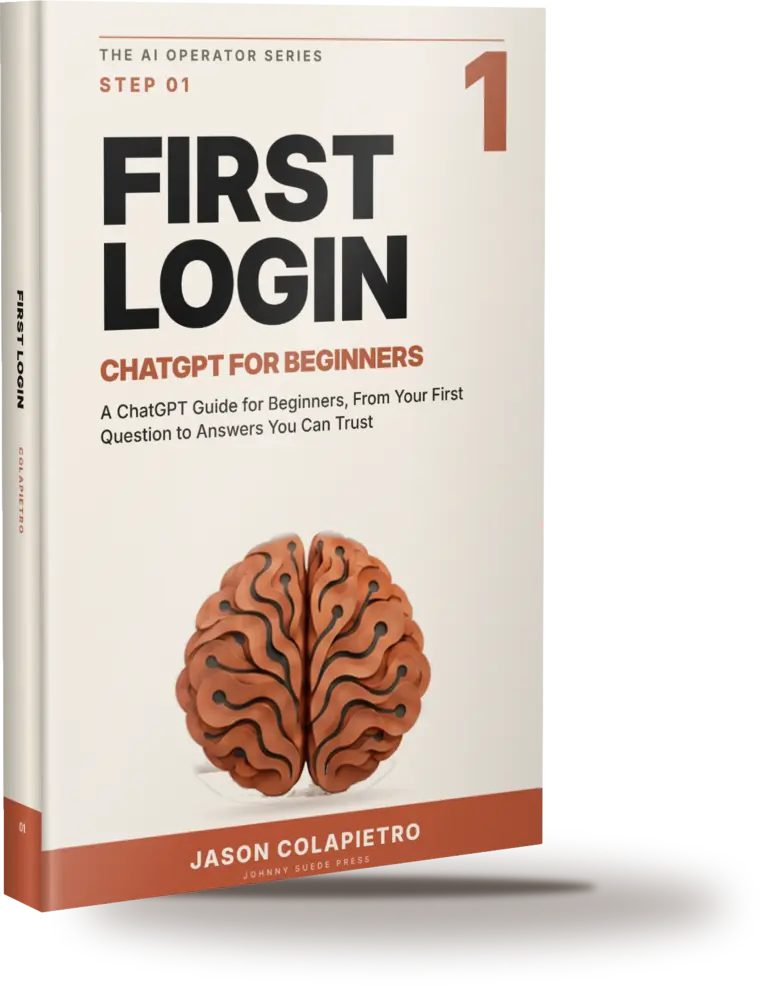
First Login
A ChatGPT Guide for Beginners, From Your First Question to Answers You Can Trust
Go from a blank chat box to a daily habit, with a library of tested prompts for the jobs you repeat every week.
The reader
Who is First Login for?
Anyone who has opened ChatGPT, typed one question and wondered what everyone else is getting out of it. You need a phone or a laptop and twenty minutes a day. No technical background.
By the last page
What will you be able to do after this book?
- Lock down your account before you paste anything personal: two-factor sign-in, the training control set on purpose, and a list of what never goes in a chat.
- Write a four-part prompt (Job, Material, Shape, Check) and fix a weak answer with one repair request instead of starting over.
- Make ChatGPT mark what it does not know, then check the claims that matter at the source.
- Turn a phone photo, a voice note and a PDF into one clean page, and get cited answers from official sources.
- Keep ten tested prompts in a library you own, with a dated export of your data and a ten-minute Friday review.
15 chapters, in order
What is inside First Login?
Chapter 1: The Blank Box
Where ChatGPT lives, what the screen does, which plan to start on (start free, upgrade when a specific limit blocks a specific job), and five questions from your own week.
Chapter 2: Lock the Door
Five minutes of settings before you paste anything personal: two-factor sign-in or a passkey, the training control set on purpose, Temporary and locked chats, ads on Free and Go, and the never-paste list.
Chapter 3: How It Answers
A no-math picture of next-token prediction, why the same question gets two answers, why it sounds sure when it is wrong, and what a new chat does and does not remember.
Jason's prompting principles turned into the four-part prompt (Job, Material, Shape, Check): turn a real customer email into a reply you could send, with every gap marked [CHECK], and save it as your first keeper.
Chapter 5: The Second Message
Stop starting over: one repair request that names the defect, points to the source, asks for the exact fix and gets a list of what changed.
Chapter 6: Check the Answer
Make ChatGPT write [CHECK], Not stated or Not confirmed instead of guessing, read the audit under the answer, and verify two claims at the source before anything goes out under your name.
Chapter 7: Talk, Show, Upload
Voice, photos, screenshots, files and pictures, each with a checkable exercise: turn a phone photo, a voice note and a PDF into one clean page, rehearse a hard conversation out loud, and know what not to upload.
Chapter 8: Ask the World
Search with citations and deep research: rank official sources first in the prompt, get Not confirmed instead of a guess, and open every link before you trust it.
Chapter 9: Tell It Who You Are
Custom instructions, style controls and memory you can see and edit, plus about-me.md, a one-page file about you that lives outside the app.
Chapter 10: Your Library
Save prompts, not outputs: keepers.md with five keepers in four-part form, each with slots, the repair that fixed it, a transfer run on someone else's facts and a short AI log.
Chapter 11: One Room per Job
ChatGPT Projects: instructions in four parts, files, memory modes and a canary question that proves a chat inside the Project reads its files, plus what to use in place of custom GPTs.
Chapter 12: Hand Off the Long Job
Automation, augmentation and agency, then one scheduled task with written limits and a freshness check that stops on stale input, with ChatGPT Work and Codex named as what comes next.
Chapter 13: Ask About Yourself
Ask what ChatGPT knows about a business you care about, run five buyer questions on two days, record who gets named, and spot absence, confusion and dead ends.
Chapter 14: What Would You Still Own?
Export your ChatGPT data, delete on purpose, keep your library in a folder you control, and pass the ownership test that every later volume aims higher.
Chapter 15: Thirty Days to Fluent
A four-week plan, the ten-minute Friday review in weekly.md, ten keepers, and three keepers carried into Claude to open Volume 2.
Table of contents for the first printing.
From Stake Your Claim
You need to communicate clearly, set constraints, and evaluate outcomes. Those are creative and strategic skills. If you can write a creative brief, you can configure an agent.
Free sample
Read Chapter 4: Generic In, Generic Out
The same request gets a better answer when it arrives as a brief: four labeled parts you will use in all five books. About 26 min. The book continues with Chapter 5, The Second Message.
Delivered by the author
Reserve Volume 1
Reserve Volume 1: First Login now and your copy is first in line when it prints. Pick this volume or the whole series in the form.
- Jason Colapietro delivers every copy personally.
- Reservations are first in line when each volume prints.
- No payment today. You confirm when your copy is ready.
Questions
About Volume 1
Is Volume 1 written for complete beginners?
Yes. Chapter 1 starts at the login screen, and every chapter has a Try this exercise you finish the same day. Readers who already use ChatGPT start at Chapter 4, where the four-part prompt begins.
Do I need a paid ChatGPT plan for this book?
Start on the free plan. A Free account covers Part I and almost all of Part II, and the book marks every feature that needs a paid plan. The rule it teaches: upgrade when a specific limit blocks a specific job.
What is in the free sample?
The free sample is Chapter 4, Generic In, Generic Out: the four-part prompt (Job, Material, Shape, Check), worked on a real customer email, with a Try this exercise that turns an email into a reply you could send and saves the prompt as your first keeper.
How do I get a copy of Volume 1?
Reserve a copy on this page. Jason Colapietro delivers every copy personally. Reservations are first in line when Volume 1 prints.