

By the end of this chapter you can:
- Explain why a vague request gets an average answer.
- Write a prompt in four labeled parts: Job, Material, Shape and Check.
- Turn a real email into a reply you could send today, with every gap marked
[CHECK]. - Save that prompt as the first entry in a library you own.
Garbage in, garbage out is the old rule, but a more precise version for creative AI is: generic in, generic out.
If you are starting here
This is chapter 4 of 15 in Book 1, and it's the chapter where your answers start getting better. You need a free ChatGPT account, ideally with two-factor sign-in turned on (chapter 2 walks through it), and about 45 minutes if you do all three exercises.
Two ideas from chapter 3 carry this one. ChatGPT writes by predicting likely text, a piece at a time, from everything in the conversation. When a fact it needs isn't there, it doesn't stop to ask. It fills the gap with something plausible.
They come from the practice files that run through this series, and every file the exercises need is printed in this chapter. Sam, who works retail and is halfway through an evening bookkeeping certificate, is the learner who goes one step ahead of you in all five books and makes each mistake before you have to. Here Sam takes the chapter's method into a job search. The names, emails and phone numbers are invented, and the prices exist only so you can check a reply against them.
The email that came in Tuesday night
Karen Ashby wrote to Harbor & Home Cleaning at 7:52 on a Tuesday evening. She lives in Scarborough, Maine, in a house of about 2,100 square feet if you count the finished basement, and she wants a deep clean before her parents arrive for Thanksgiving. Then came a numbered list she apologized for: the price, windows inside and out, products safe for a golden retriever who licks the floors, the living room carpet, cash, a discount for regular cleaning, a morning the week of November 16, and whether the team is insured.
Dana Ruiz owns Harbor & Home. The next morning she copied the whole email into ChatGPT, typed one line above it, Write a reply to this customer, and pressed send. A reply came back in seconds.
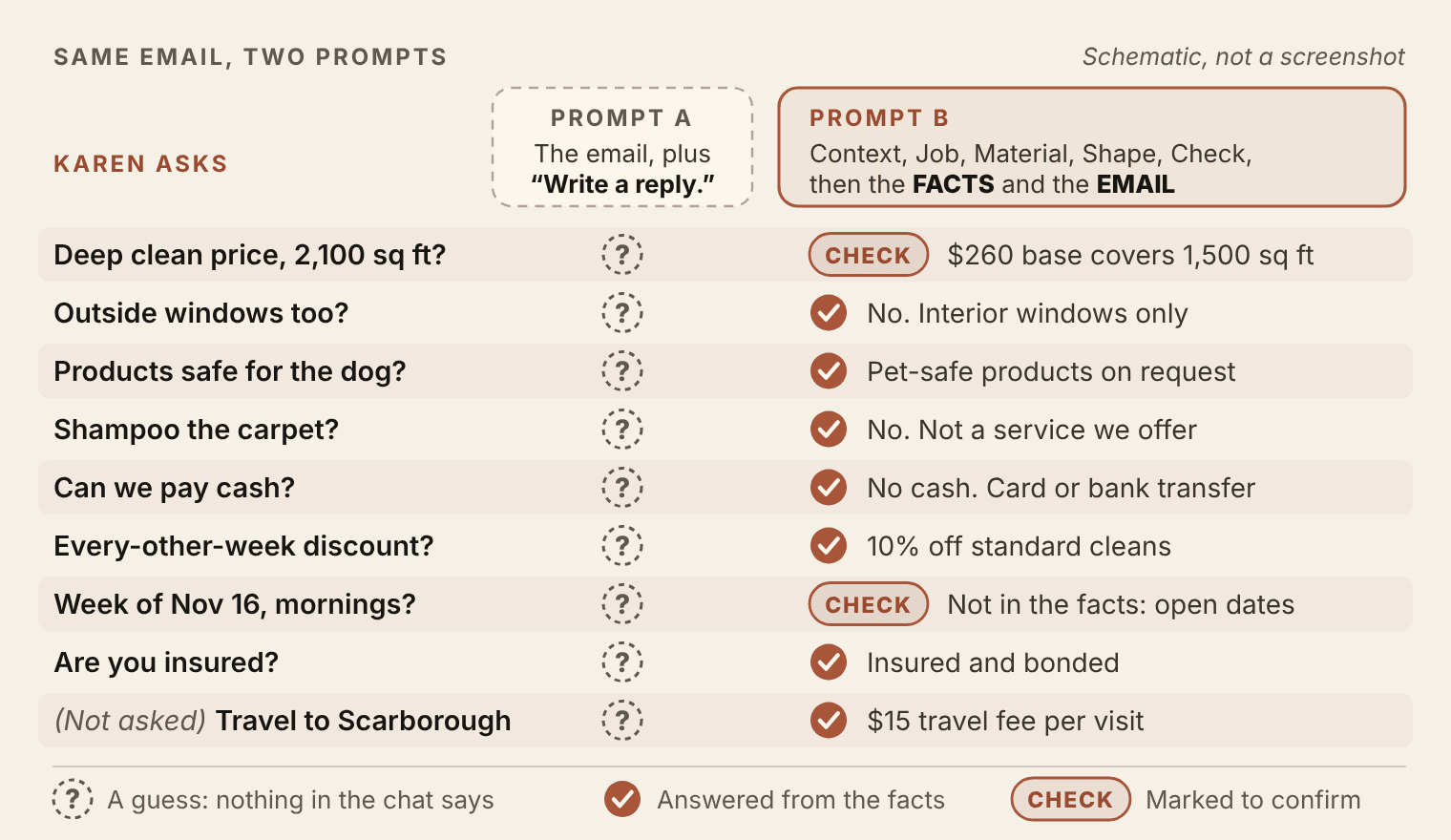
Here is what that reply could not know. Harbor & Home doesn't shampoo carpets or clean exterior windows, and it never takes cash. Its deep-clean price is published only for homes up to 1,500 square feet. Scarborough carries a $15 travel fee per visit. The 10 percent discount applies only to regular standard cleans, and Dana's open mornings live in her calendar and nowhere else. Every one of those facts was on a single page on Dana's laptop, and none of them was in the chat.
So whatever the reply said about price, carpets, cash or dates, the model supplied it without being told. The answer key in the practice files lists the mistakes a reply to Karen tends to make: specific days offered, a yes to the outside windows or the carpet, a missing travel fee, the discount applied to the deep clean, an exclamation point Dana would never use. Each one is a promise she'd have to take back on the phone.
I won't print a reply here and call it the one you'll get. Yours will differ from the next reader's, and from your own second try, so the first exercise has you send that one-line request yourself and count what it had to invent.
Why the answer comes back average
Chapter 3 gave you the mechanism. The model writes the most likely next words given everything in front of it. Hand it Karen's email and nothing else, and the most likely reply is the one an average cleaning company would send: courteous, organized, and built from what cleaning companies usually do. Usually is the problem. Plenty of cleaning companies shampoo carpets and take cash, and the model has no way to know this one does neither.
That's what I mean by generic. The writing isn't bad. It's about nobody in particular. Garbage in, garbage out assumes the input was wrong, and Dana's input wasn't wrong. It was thin, and a thin request gets the average of everyone who might have sent it.
Most of us learned to talk to computers through a search box. You type four words, the engine ranks pages that already exist, and you pick one. Short works there because the pages are already written. A chat model writes a new page for you on the spot, and it can only write about what it was told. Typing "reply to this customer" into ChatGPT is the search-box habit pointed at a different kind of machine.
The same thing happens at home and at the office. Ask for dinners for this week and you get a tidy plan built around groceries you may not have. Ask for an agenda for Thursday's meeting and you get the agenda for a meeting in general. Nothing in either answer is wrong, exactly. None of it is yours.
The fix is not technical. Picture a capable new hire on their first morning: quick and careful, and new to your business. You wouldn't hand that person Karen's email and walk away. You'd say something like this: here's our price sheet, we don't do carpets, we don't take cash, keep it short, answer her in order, and don't promise a date until I've looked at the calendar. That little speech is a prompt. Most people could give it out loud to a person without a second thought. They rarely think to give it to the machine.
I want to start with the misconception that keeps most artists from extracting value from AI tools, which is that prompt quality is a technical skill. It is not. It is a communication skill. If you can brief a collaborator, you can write an effective prompt.
I said that to working artists, and it holds for anyone with an inbox. Figure 4.1 lays Karen's questions beside two versions of Dana's request. Karen's questions run down the left. The middle column is the email plus one line; the right column is the brief with the facts attached. Look down the middle column. Every row is a guess.
Three principles from one workshop
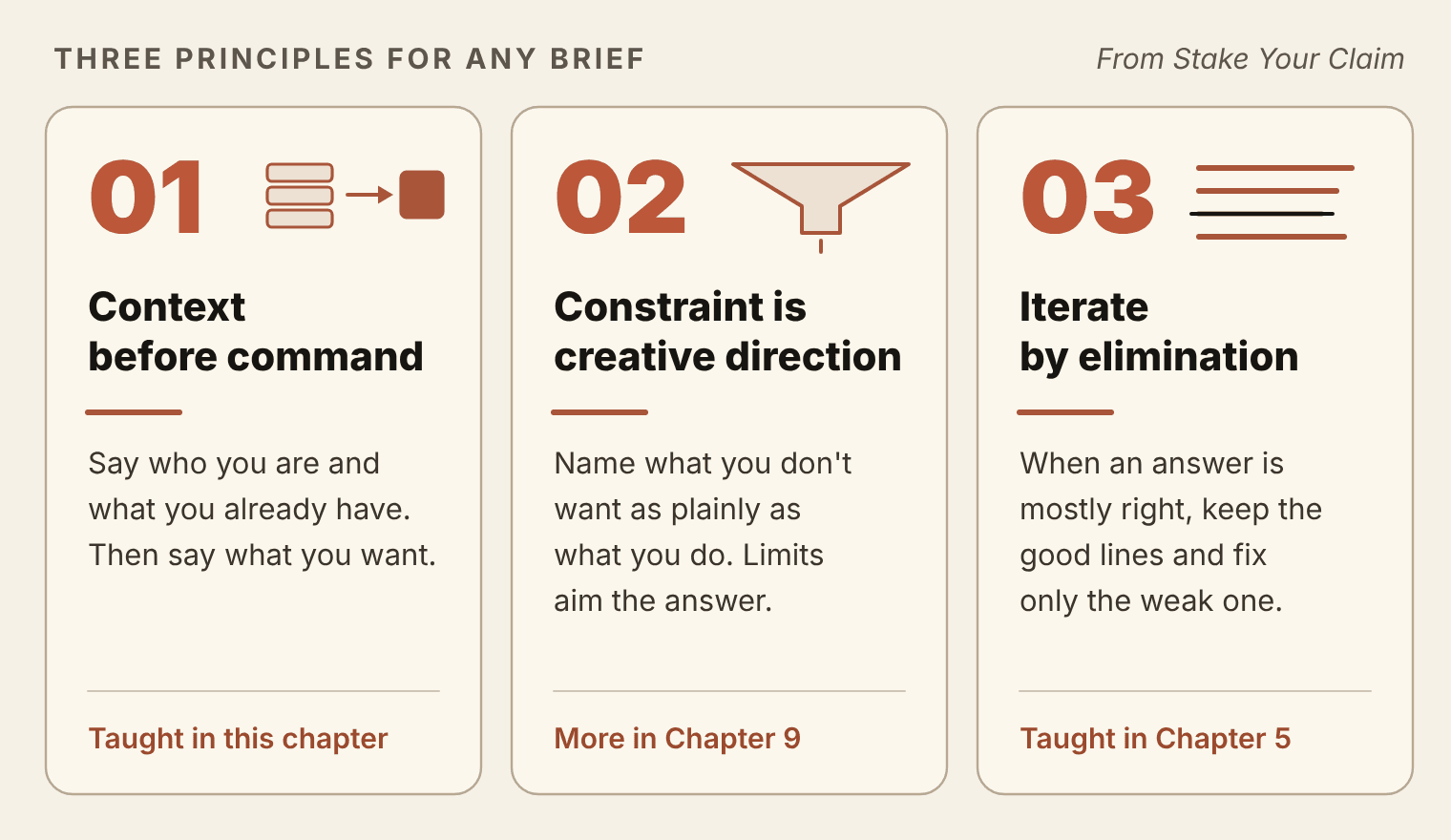
The "communication skill" callout above opens a workshop on prompting, printed in Stake Your Claim as "Prompt Engineering for Working Artists". In it I gave three principles for briefing any AI tool, and they work just as well for a cover letter or a page on your own website. Figure 4.2 puts them on one card.
Context before command
The first principle is the one that fixes Dana's reply. Before you say what you want, say who you are and what you already have. The model needs to know where its answer will live before it can write something that belongs there.
One: Context before command. Don’t start with what you want. Start with who you are and what you have already done.
Here is the same move on a different job. Dana wants a better title for the deep-clean page on Harbor & Home's website, the page title that usually shows in search results. The thin version asks for a title for a cleaning company's deep-clean page. The briefed version says who she is and which towns she serves, names who the page is for (people like Karen, getting a house ready for guests), pastes the page as it reads now with the questions customers ask most, and only then asks for five title options in the voice the rest of the site uses. The two requests come back with very different titles, because only the second tells the model anything about Harbor & Home.
For everyday work, context comes in a few kinds, and a short request may need only two of them:
- Who you are. "I run a small cleaning company in Portland, Maine."
- What it may use. The price sheet, the policy, your notes from the call.
- Who will read the result. "A prospective client who has not booked yet."
- What happened before. "She asked last week and I never answered" changes the whole reply.
For Karen's reply, Dana's context is one sentence and a pasted page. The sentence, "I run Harbor & Home Cleaning, and I need a reply to a customer email," takes ten seconds to type. It changes what every line after it is about.
Constraint is creative direction
The second principle treats every limit as a direction you give the model. People leave constraints out because they feel fussy, as if the model should know better. It can't. Each constraint closes off a wrong turn it would otherwise take.
For a customer email the useful constraints are usually a word limit, the order of the answers, the tone, what not to promise and what not to invent. "No exclamation points" tells the model whose voice it's writing in. "Answer the questions in the order the customer asked them" lets Karen check the reply against her own list. And "Do not add prices, services, promises or dates that are not in the facts" keeps Dana out of a commitment she never made. None of these lines asks for better writing. They point the writing somewhere.
Say what you don't want as plainly as what you do. Chapter 9 comes back to this, when the constraints you keep repeating turn into a description of your own voice.
Iterate by elimination
The third principle belongs to the second message, so I'll keep it short here. When an answer is mostly right, don't start over. Keep what works, name the line that's wrong and ask for a fix to that line only. Starting over throws away the good parts and rolls the dice again. Chapter 5 is built on this one move.
The four-part prompt
The principles tell you what to think about. The four-part prompt gives each thought a place to sit, so you don't have to hold the principles in your head while you write. Every prompt in this series uses it, from Karen's email here to the client playbooks in Book 5. It has four labeled parts.
Job says what you want, who it's for and what done looks like. Dana's Job line reads: "Write a reply I can send today. It should answer every question in the email and make it easy for them to book." Notice today. It tells the model Dana wants a finished email she can send, with no blanks left for her to fill in later.
Material is what the model may use, with a fence around it: "Use only the approved business facts below. Do not add prices, services, promises or dates that are not in the facts." The word only is the fence. Without it, the facts are a suggestion, and the model's sense of what cleaning companies usually do fills in the rest.
Shape covers length, structure, order and tone, and who signs. Dana's runs to five short sentences: under 220 words, warm and direct with no exclamation points, answers in the customer's order, one clear next step, signed Dana.
Check tells the model what to do when the facts run out, and asks it to show its work. Most people leave this part out, and it's the one that matters most when a customer will read the result. Dana's Check gives the model a specific thing to write instead of guessing, [CHECK: what I need to confirm], placed in the reply at the exact spot the missing fact belongs. Then it asks for a short list under the email: each [CHECK] item, then every price quoted and the fact that price came from.
That list turns proofreading into a one-minute job. Dana doesn't reread 200 words hunting for an invented promise. She confirms each [CHECK] item and holds each quoted price against the line it came from. Chapter 6 turns this into a habit for any answer that matters.
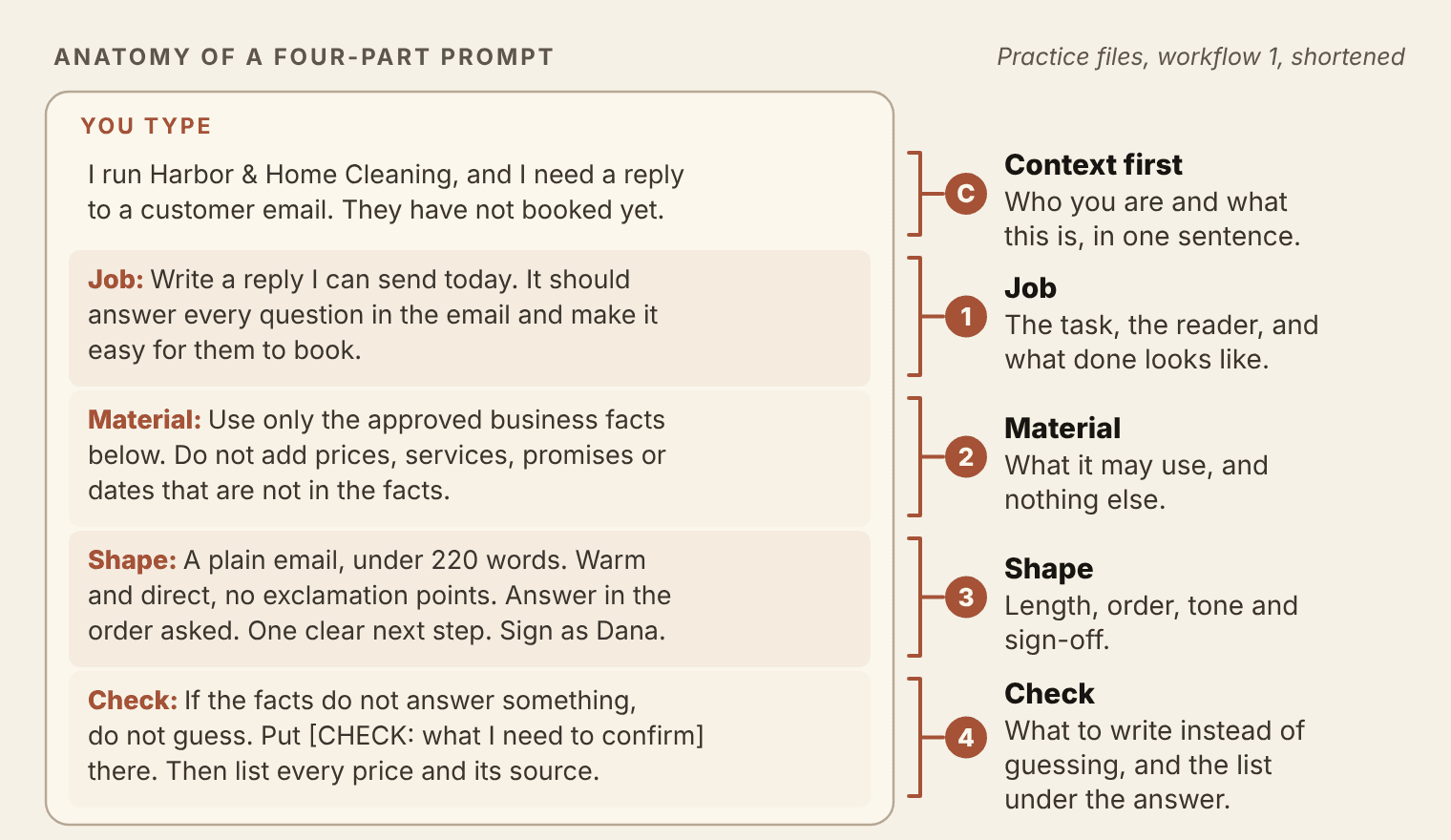
Look at the sentence that sits above Job: "I run Harbor & Home Cleaning, and I need a reply to a customer email. The customer is a prospective client who has not booked yet." That's context before command, in practice. The labels come after it. The rule isn't that every prompt must open with a context sentence. The rule is that the command never travels alone.
If you've read my AI fluency guide at the back of Stake Your Claim, you've seen a longer checklist there: five elements of a professional prompt. That checklist is mine. I filed it under Description, one of the four skills in the AI Fluency Framework, created by Rick Dakan of Ringling College of Art and Design and Joseph Feller of University College Cork and taught in a free course they built with Anthropic. Chapter 6 says more about that framework. Here's where each of the five lands in the four parts.
- Intent goes in Job.
- Context goes in the opening sentence and in Material. Examples go in Material too, since a past email you liked is something the model may use.
- Format and constraints both go in Shape.
- Check is the part the five elements leave to your judgment. For anything a customer, a boss or a landlord will read, write it down instead.
Answer Karen
Time to run it. The exercise has two rounds on purpose: the bare request first, then the brief, on the same email. You'll see the difference yourself instead of taking my word for it, and you'll keep the prompt that wins.
As of November 2026: Temporary Chat. Both rounds run in a Temporary Chat, which chapter 2 showed you how to open. A Temporary Chat stays out of your chat history unless you choose to save it, which turns it into an ordinary chat. While it stays temporary it doesn't create or update saved memories and isn't used to train models, although OpenAI may keep a copy for up to 30 days for safety. Since late August 2026 you can choose to bring your personalization into a temporary chat when you start one. For this exercise, leave it out, so both rounds start from the same blank page and the only difference is what you typed.
Watch out. A real customer's email carries a real name, address and phone number. Before you paste one, cut what the reply doesn't need (it doesn't need her phone number) and use a Temporary Chat. Never paste a password, a card number or anything you'd regret seeing in a chat log.
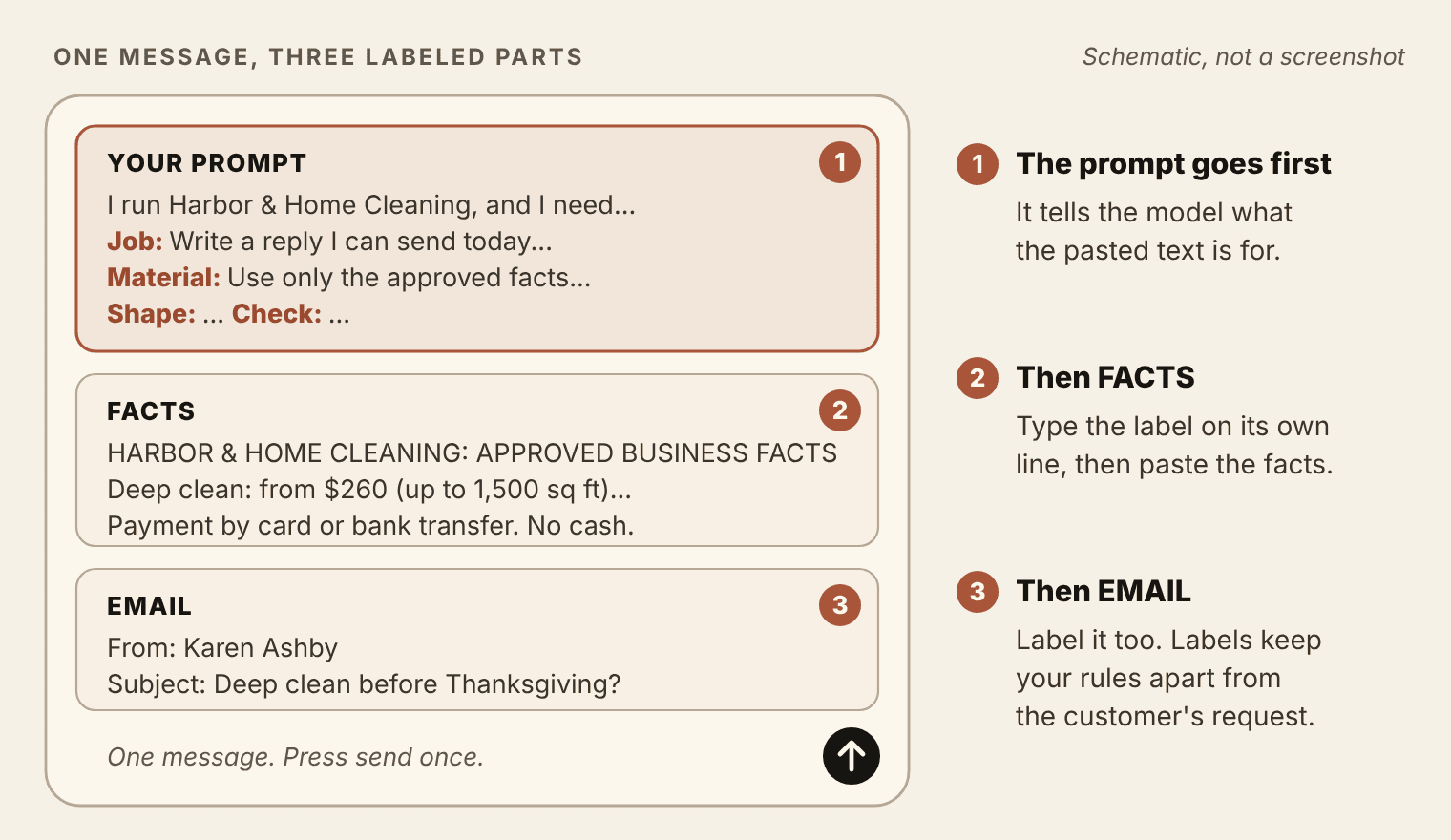
The briefed round goes in as one message with three labeled parts, in the order Figure 4.4 shows.
When both rounds are done, put Run A and Run B side by side and look only at the sentences you marked in step 2. In Run B, each of them should trace to a line in the facts or sit inside a [CHECK]. If one does neither, you've found a gap your Check part missed. Better to find it now than to have Karen find it.
Practice file: Harbor & Home approved facts
HARBOR & HOME CLEANING: APPROVED BUSINESS FACTS


Owner: Dana Ruiz
Location: Portland, Maine. Office at 214 Fore Street, Suite 3 (no walk-in service).
Phone: 207-555-0142   Email: hello@harborhome.example.com
Office hours: Monday to Friday, 8:00 a.m. to 5:00 p.m. Phone messages returned within one business day.
Team: 7 cleaners (all employees, not contractors), plus Dana.
Insured and bonded: yes (general liability and bonding; certificate available on request).

SERVICE AREA
Portland, South Portland, Westbrook, Falmouth, Cape Elizabeth.
Scarborough and Yarmouth by request, with a $15 travel fee per visit.
No service on the islands.

SERVICES AND PRICES
Standard home clean: from $140 (up to 1,500 sq ft). Add $25 per extra 500 sq ft.
Deep clean: from $260 (up to 1,500 sq ft). Includes inside oven, baseboards, interior windows.
Move-out / move-in clean: from $320 (up to 1,500 sq ft). Empty homes only.
Small-office clean: quoted after a free walk-through. Evenings only (after 5:30 p.m.).
Add-ons: inside fridge $35, inside cabinets $45, laundry fold $25 per load.
Recurring discount: 10% off standard cleans booked weekly or every two weeks.
Minimum visit: $120.

HOW BOOKING WORKS
New clients book a first visit by phone or email. First visits for homes over 2,500 sq ft need a free 15-minute video walk-through.
Payment by card or bank transfer after each visit. No cash.
Cancellation: free up to 48 hours before the visit. Inside 48 hours, a $50 fee.
Lockouts (team cannot get in): charged at the full visit price.

SUPPLIES
Team brings all supplies and equipment.
Default products are fragrance-free. Clients may supply their own products.
Pet-safe products used on request.

WHAT WE DO NOT DO
No mold remediation, biohazard cleaning, carpet shampooing, exterior windows, or work above 8 feet on a ladder.
No pet waste cleanup.

GUARANTEE
If something was missed, tell us within 24 hours and we return to fix it at no charge.

NEW IN SPRING
Move-out cleaning package for renters: move-out clean plus inside fridge and inside cabinets for $380 (up to 1,500 sq ft). Launches March 1.
Practice file: Karen's email
From: Karen Ashby <kashby@example.com>
To: hello@harborhome.example.com
Date: Tuesday, October 27, 2026, 7:52 p.m.
Subject: Deep clean before Thanksgiving?

Hi there,

My neighbor Joan Mercer used you last spring and said really good things, so I thought I'd reach out. We live in Scarborough, off Black Point Road, and I'm hoping to get a deep clean done before my parents come up for Thanksgiving. They're staying with us for a week and my mother notices everything.

The house is about 2,000 square feet. Maybe closer to 2,100 if you count the finished part of the basement, which I would want done too since that's where they'll sleep.

A few questions, sorry in advance for the list:

1. What would a deep clean cost for a house our size? Does that include windows? The outside ones are pretty grimy after the summer, and the inside ones have nose prints all over them (see below).

2. We have a golden retriever, Biscuit, so there is a LOT of fur. Are the products you use safe for dogs? She licks the floors, which is gross but true.

3. Could your team shampoo the living room carpet while you're here? It's the one room I'm embarrassed about.

4. Do you take cash? My husband prefers to pay that way.

5. If this goes well we'd probably want someone every other week after that, just regular cleaning. Is there any kind of discount for that?

6. Could you come the week of November 16? Any day but Wednesday works. Mornings are best because I work from home in the afternoons.

Also, are your people insured? The last company we used broke a lamp and it turned into a whole thing with them.

Thanks so much. Feel free to call if that's easier. I'm usually around until noon.

Karen Ashby
207-555-0174
Sam's step: the follow-up nobody answered
The four parts aren't about cleaning companies, and Sam goes first to prove it, on a job search.
On October 14, Sam interviewed for a part-time bookkeeping assistant job at Kessler & Moore CPAs with the office manager, Janelle Ortiz, who said they'd decide by October 23. In the interview she asked for a reference from a current supervisor, and Sam promised one after asking first. The thank-you email that night repeated the promise. On October 21 the store manager, Denise, said yes: call the store at 555-0144 and ask for her, weekday mornings before 11. The last line in Sam's notes, dated October 27, says Janelle still hasn't written. Early in November she still hasn't, and Sam sits down to write a follow-up.
Sam's first instinct is the one most of us have: Write a follow-up email to my interviewer. Look at what that request leaves out. It never mentions the reference, which is the one thing Janelle asked for and the best reason for her to open the email. The decision date that came and went isn't in it, and neither is Sam's wish to get an answer without sounding pushy. A model given that line can only write a follow-up email to an interviewer, about nobody in particular.
Here's the briefed version from the practice files.
I need a follow-up email after a job interview. I have not heard back.

Job: Write a short follow-up to Janelle Ortiz, office manager at Kessler & Moore CPAs, who interviewed me for a part-time bookkeeping assistant job. She said they would decide by October 23, and that date has passed. The goal is a reply, not pressure. Make the email worth opening: give her my reference's details, since I said I would send them.

Material: Use only my interview notes and the thank-you email I already sent her. Do not repeat my whole thank-you email.

Shape: Under 120 words, plus a subject line. Open with something useful, not with "just checking in" or "following up." End with one easy question she can answer in a line. Polite and plain. Sign off as Sam Rivera.

Check: Do not add skills, dates, hours or promises that are not in my notes. After the email, list anything in my notes you think I should sort out before I send it.

My interview notes come first, then the thank-you email I sent.
All four parts are there, in a different life. The Job names the reader and asks for a reply without pushing for one. It also gives the email a reason to exist: the reference Sam promised. Material keeps the facts inside Sam's own notes and the thank-you already sent. In the Shape, the two openers that make a follow-up feel like a nudge are banned and one easy question closes the email, while the Check rules out invented skills, dates, hours or promises before asking for a list of loose ends.
That list is where the brief pays for itself. In the practice files' example result, the list under the email flagged four things Sam hadn't settled. Denise's last name and the store's name weren't in the notes. The store number had no area code. Sam had told Janelle "probably more hours" for January to April without deciding how many. And nobody knew whether the job was still open. None of that belonged in the email. Any of it could have come up on the phone call the email was trying to earn.
Practice file: Sam's interview notes
MY NOTES: INTERVIEW AT KESSLER & MOORE CPAs
Part-time bookkeeping assistant (20 hrs/week)
Wed Oct 14, 2026, 10:30 a.m., in person. About 35 minutes.
Interviewer: Janelle Ortiz, office manager. janelle.ortiz@kesslermoore.example.com
(Sam Rivera, written on the bus right after, cleaned up that night)

What the job is
- Entering bills and receipts for small business clients, matching bank statements, filing.
- They use cloud accounting software. Training provided. She said they care more about "careful and reliable" than about experience.
- Busy season is January to April. They want someone trained before January.

What went well
- She liked that I'm halfway through the bookkeeping certificate (evening classes, Tues and Thurs). Asked what we've covered. I talked about debits and credits and the bank reconciliation unit. She said "that's most of what the job is, honestly."
- Talked about my retail job: cash drawer counts, closing reports, never been short more than a couple of dollars in 3 years.

What I wasn't sure about
- She asked for a reference from a current supervisor. I said I'd have to ask my store manager first, because I haven't told work I'm looking. I felt like I lost points there.
- Asked about my availability for January to April. I said probably more hours, but I wasn't sure. (Part 2 of the certificate starts in January, Tues and Thurs evenings. The job is daytime, so no clash.)

What happens next
- She said they'd decide "by the end of next week" (that's Fri Oct 23). Two other people interviewing.
- Sent thank-you email that night (see other file).

UPDATE Wed Oct 21
- Talked to my store manager, Denise. She said YES, she's happy to be a reference. She said to give out the store number, 555-0144, and ask for her. Best time to reach her is weekday mornings before 11.

UPDATE Tue Oct 27
- Nothing from Janelle. It's past Oct 23. Don't want to be annoying. Don't know if they picked someone else.
Practice file: Sam's thank-you email
From: Sam Rivera <sam.rivera@example.com>
To: Janelle Ortiz <janelle.ortiz@kesslermoore.example.com>
Date: Wednesday, October 14, 2026, 9:12 p.m.
Subject: Thank you: bookkeeping assistant interview

Hi Janelle,

Thank you for meeting with me today about the part-time bookkeeping assistant role. I enjoyed hearing how the team works with small business clients, and it was good to hear that the bank reconciliation work I'm learning in my certificate course is a big part of the job.

I'm very interested in the position. I'll ask my current manager about being a reference and send you her details.

Thanks again for your time.

Best,
Sam Rivera
sam.rivera@example.com
From vague to briefed, one step at a time
You don't have to write all four parts at once, and the first time, it helps not to. Each part closes a different gap. Add them in order and you can watch the answer change, step by step, the way Figure 4.5 draws it.
The bottom step is the bare request, and it gets the average answer. Add context and material and the reply becomes about Harbor & Home instead of cleaning companies in general. Shape and limits come next; now it arrives at the right length, answers Karen in her order and sounds like Dana. The check is the top step. It turns a plausible email into one Dana can verify in a minute instead of rereading for ten.
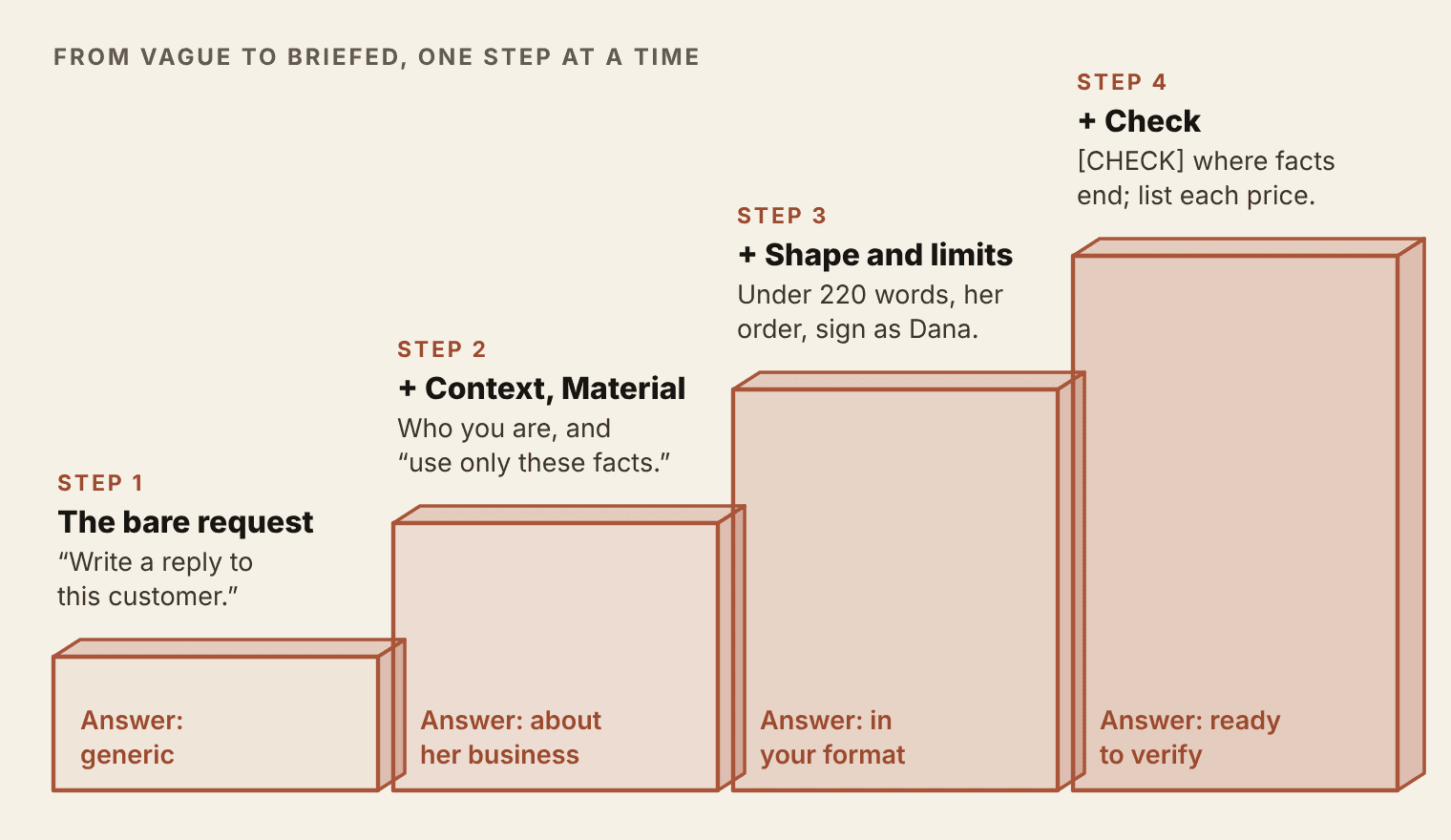
In my AI fluency guide I printed only the bottom step and the top one: a one-line request and a fully built professional prompt. The middle steps are the ones people actually climb, so they're drawn here.
One more thing about the top step. Your first briefed reply will often be close and still wrong in one place, a phrase too stiff or one fact in the wrong order. Don't climb back down. Keep the reply, name the one thing that's wrong and ask for that fix alone. That's iterate by elimination, and it's the whole of chapter 5.
Save this: Keeper #1
The reply was for Karen. The prompt is for you. You'll answer dozens of emails like hers, so save the prompt with the business details swapped for slots, and the next one takes a minute.
Open library/keepers.md, the plain text file you started in chapter 1, and add Keeper #1 below your Day One entry. The never-paste list, your settings lines and the three lines from chapter 3 stay where they are, at the top. If you're starting here, make a folder called library somewhere you control, on your computer or in your own cloud drive, and a plain text file inside it called keepers.md (on a Mac, choose Format > Make Plain Text in TextEdit before you type; Notepad on Windows saves plain text already). Chapter 10 builds this file into a real library, and chapter 14 explains why it lives outside ChatGPT. On a phone, a note titled keepers.md in your notes app works until you're back at a computer.
library/keepers.md

## Keeper #1: Reply from approved facts
Saved: [TODAY'S DATE]
Use it for: any email you answer from facts you control

I run [BUSINESS], and I need a reply to a customer email. The customer is [WHO THEY ARE].

Job: Write a reply I can send today. It should answer every question in the email and make it easy for them to [NEXT STEP].

Material: Use only the approved facts below. Do not add prices, services, promises or dates that are not in the facts.

Shape: A plain email, under [WORD LIMIT] words. [TONE]. Answer the questions in the order they were asked. End with one clear next step. Sign off as [SIGN-OFF].

Check: If the email asks something the facts do not answer, do not guess. Put [CHECK: what I need to confirm] in the reply at that spot. If a price depends on a detail you do not have, explain how the price works and flag it. After the email, list each [CHECK] item, then list every price you quoted and the fact it came from.

FACTS
[FACTS]

EMAIL
[EMAIL]

Repair that fixed it:
Transfer run:
Words in capitals inside brackets are slots. Change them each time you use the keeper. [CHECK: what I need to confirm] is not a slot, so leave it exactly as written. The last two lines stay blank for now. Chapter 5 fills in the repair that fixed your first run, and chapter 10 runs the keeper on a second person's facts to prove it travels.
Where this pays. Book 5, Chapter 2, Pick the Offer. The sentence that sells your work is a brief too, written for one buyer about the problem you solve for them.
Landing
You can now:
- 1.4 Write a four-part prompt that turns a real email into a reply you could send.
- Label the parts of any prompt you read, and spot the missing one when an answer comes back generic.
- Run a request bare and briefed, and tell which lines came from you and which the model made up.
Carry forward: Keeper #1 in library/keepers.md.
Next: Chapter 5, The Second Message. Your first briefed reply will be close, and close is where most people either settle or start over. The second message, the one that names exactly what's wrong and asks for that fix alone, is where the reply gets good. Chapter 5 shows you how to write it, and how to get back a list of what changed.
Book 1 of 5 · Chapter 4 of 15