

By the end of this chapter you can:
- Write a frozen set of ten buyer questions, each marked discovery or branded.
- Capture answers from four AI engines as evidence, with the date and the session conditions written down.
- Score a question-by-engine grid that counts an empty answer as an engine failure and keeps it out of the misses.
- Turn the gaps into a fix list in severity order, and keep one dated screenshot as your first sales asset.
If you are starting here
This is chapter 6 of 15 in Book 5, the book about turning what you can do with AI into a business that lands clients. Four ideas from earlier chapters help here.
- `library/` is a folder of your own files that grows through the series. What you make in this chapter goes into
library/playbooks/visibility-scan/andlibrary/scans/. - The four-part prompt. Every request in this series names the Job, the Material the AI may use, the Shape of the answer and the Check it runs when a fact is missing.
- Chapter 5 fixed the inputs on your own site: whether AI crawlers can read it, passages that answer first, and markup that matches the page.
- Harbor & Home Cleaning is a house-cleaning company in Portland, Maine, owned by Dana Ruiz. Sam Rivera keeps Dana's books part time and goes one step ahead of you through the series, making the mistakes first. In this book Sam turns that work into a small service for other businesses. Every question, answer and score about Harbor & Home is practice data. Every story about my own practice comes from what I have published.
You need under three hours across the three exercises, a browser, a spreadsheet and a screenshot tool. Free accounts are enough. You run the scan by hand here, which is how you learn what Book 3's scheduled version is doing.
The baseline I threw out
In the summer of 2026 I ran the first scan of my own company: a set of buyer questions, put to more than one engine, every answer saved to disk. One result jumped off the page. One of the engines had never named us. Not in a single answer.
That is the finding a person who sells scans hopes for. It would have made a great slide. It was also wrong.
When I opened the answer files from that engine's run, all twenty were empty. Zero bytes. The engine answered fine when I typed the same questions by hand. What had changed was the command-line tool my script called: an update moved part of its output to a different stream, and my script was still reading the old one. It got back nothing, and nothing looks exactly like an engine that chose somebody else.
I threw the baseline out publicly, made an empty answer stop the run with an error, and ran the set again. The rule that came out of it runs through this whole chapter. An empty answer is a broken instrument, not a result. A miss counts only when the engine gave a real answer and that answer named somebody else.
I found that bug on my own company, where a wrong number cost me an evening and a correction. Found on a prospect, after I had sent them the slide, it would have cost me the client and the right to be believed. So you measure yourself first, and only then anyone else.
Named or not named
Page two of a search result was harsh, but you could see it: search your own trade, scroll, and find yourself at position fourteen. In plenty of trades a business at position seven on page one still got enough clicks to live on.
An AI answer has no position fourteen. A renter in South Portland asks an assistant who does move-out cleaning, and the answer names three or four companies with a sentence on each and maybe a link. Harbor & Home is in that paragraph or it is not. The curve that used to describe visibility has turned into a step: named, or not named.
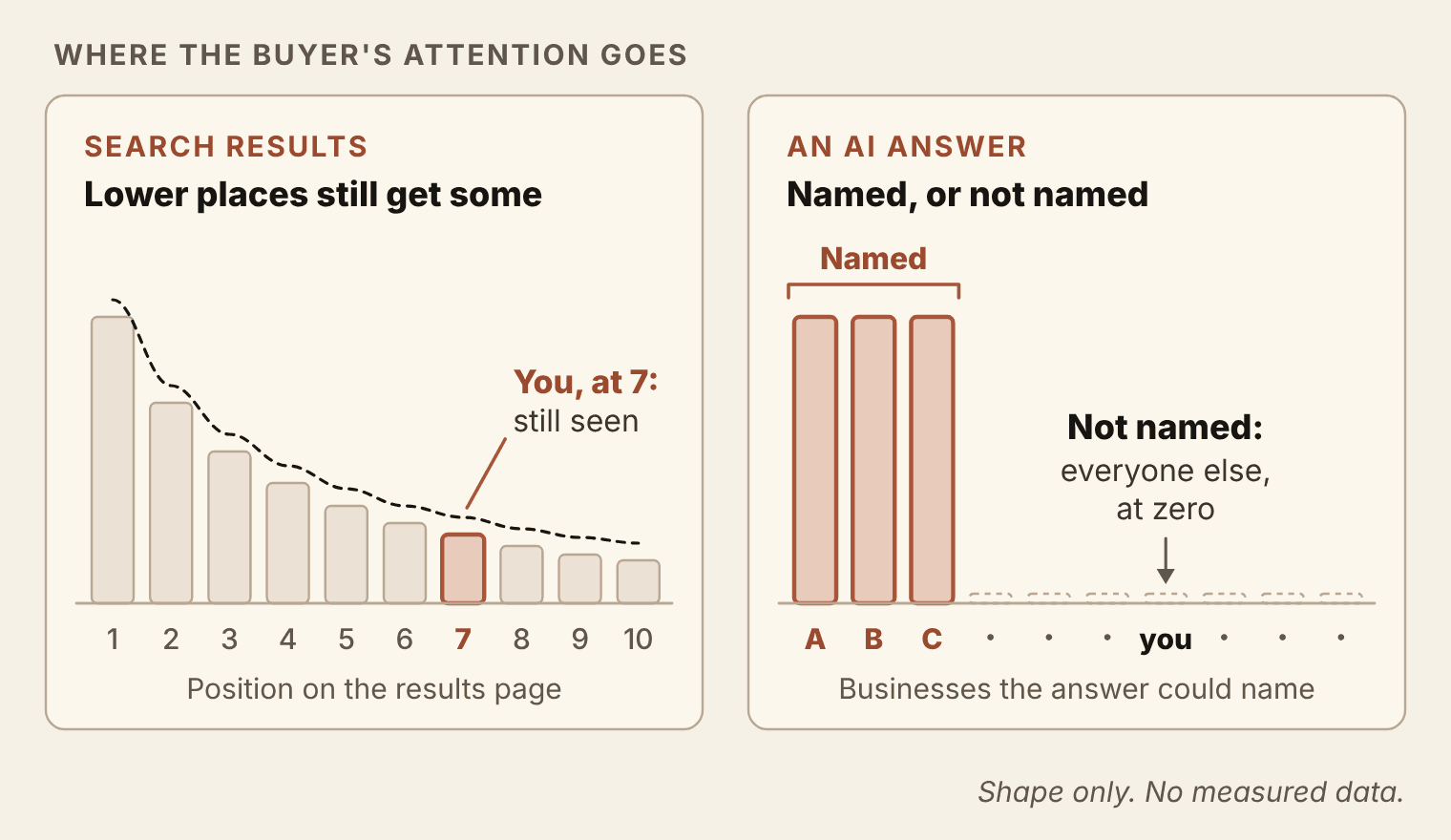
The second problem is silence. When you slip in search, something tells you: traffic falls, or a competitor's listing turns up where yours used to be. When an engine leaves you out of an answer, nothing happens. The buyer calls someone else, and you never learn the question was asked. Nothing reports it unless you go and ask, which is the whole job of this chapter.
The person asking is not always a person, either. Assistants already compare options and draft the shortlist for the human, and the next step, software that contacts or books a business on its own, is being built now. I made this point in Stake Your Claim, in a workshop chapter on negotiating licenses. The setting was narrow. The logic was not.
The brand whose agent is searching for licensable music at three in the morning does not send a “contact us” form. It queries available licenses, evaluates terms, and executes. If your terms are not queryable, you are not in the results.
For a cleaning company, a bookkeeper or a web studio the translation is direct. If your service area, your prices, what you will and won't do, and how to book are not written somewhere a machine can read and repeat, you are not in the results, whether the one asking is a homeowner or a program working for one. Chapter 5 fixed what you publish. This chapter checks whether any of it reached the answers.
Yourself first
Run the first scan on your own business, even if you doubt anyone asks an assistant about you. You will learn more from that scan than from any other you run.
You know your own facts cold. When an engine quotes last year's price, you catch it in a second; on a stranger's business you would nod.
Your instrument will also have bugs, and you want to find them where they are cheap. Mine did. Yours will be smaller, a session you forgot was signed in or a question you reworded halfway through, and you should find it before anyone you hope to bill does.
Then there is the receipt. A dated scan of yourself, losses included, is the most persuasive thing a visibility practice can show a stranger, and chapter 7 turns it into a public page. I published my own losses before I charged anyone for a scan: the buyer questions where competitors were named and my company was not, sitting next to the names that won.
The service I run now grew out of a pattern I kept seeing. Founders with good products were losing deals they never knew existed, because the buyer had asked an engine for options, received three to five names, and decided inside that list.
So I started running the check for people. Ask the engines the questions their buyers ask, several different ways. Capture every prompt and every answer with timestamps. Count who gets named. Put the screenshots in front of the founder. Then, for the ones who wanted it, ship the actual repairs the same day: the structured data, the machine-readable files, the rewritten page sections that give an engine something worth citing.
That paragraph is the method, and the rest of this chapter teaches it in the order I run it, by hand, with no code.
Before you read on, make a folder named for your business and today's date, library/scans/<your-business>/<date>/, and write one line in a README.md inside it: the business you are scanning and why.
The prompt set
A keyword is what someone types into a search box: "house cleaning Portland". A buyer question is what someone asks an assistant once they have decided to spend the money: "Who does move-out cleaning in South Portland that a landlord will actually accept?" The second carries a place, a kind of customer, a worry and a decision. Engines answer questions like that all day, so that is what you test.
Write ten to twenty questions, spread across the five angles a buyer takes:
- What the service is. "What does a deep clean include?"
- The best option for a specific customer in a specific place. This is where most money questions live.
- You against the competitor you lose to. Name the real one.
- How to solve the underlying problem, where hiring someone is one answer among several.
- What it costs.
Then mark every question one of two ways. A discovery question names no business: "Who does move-out cleaning in South Portland?" It tests whether an engine finds you when the buyer has never heard of you. A branded question names you: "Is Harbor & Home Cleaning insured?" It tests whether the engine knows you and gets your facts right. Keep the two apart on the scorecard. A company that engines know by name but never suggest has a different problem, and a different fix, from one that gets suggested and described wrong.
Don't make the questions up. Take them from the places buyers already speak: the inquiry inbox, sales-call notes, reviews (customers often say why they chose you), and the questions whoever answers your phone hears every week. Keep the buyer's words, including the awkward ones. I also give each question a buying-intent score from 1 to 5. The score does nothing while you capture. It sorts the report, so the most expensive losses sit at the top.
Then freeze the set. Put the date at the top and never edit a question in place again. If one turns out to be badly worded, retire it and add a replacement with its own start date. A reworded question starts a new history, and its old answers no longer line up against the new ones. Lining them up month after month is the point of the scan.
Here are Harbor & Home's ten, the practice set for this chapter:
- What does a deep house clean include that a regular clean doesn't? (discovery; what it is)
- Who are the best house cleaners in Portland, Maine for a home with two dogs? (discovery; best for)
- Who does move-out cleaning in South Portland for renters? (discovery; best for)
- Is there a fragrance-free house cleaning service near Falmouth, Maine? (discovery; best for)
- How do I make sure I get my security deposit back when I move out of an apartment in Maine? (discovery; underlying problem)
- How much does a deep clean cost for an 1,800 square foot house in Portland, Maine? (discovery; cost)
- Should I hire a cleaning company or an independent house cleaner in Westbrook, Maine? (discovery; versus)
- Is Harbor & Home Cleaning insured and bonded? (branded)
- Harbor & Home Cleaning or [Competitor A] for a weekly clean in Cape Elizabeth? (branded; versus)
- Does Harbor & Home Cleaning bring its own cleaning supplies? (branded)
Seven discovery and three branded is a sensible first split. Discovery finds new customers; branded questions catch the wrong facts that cost you the ones who already found you.
Capture it like evidence
An answer you didn't record is an anecdote. Treat every capture as evidence someone else may check later, because once you sell this, someone will.
Use four engines: ChatGPT, Claude, Gemini and Perplexity, the same four my own free scorecard uses for a client's questions. Perplexity shows its sources on nearly every answer, which makes it the easiest place to see which pages did the work. ChatGPT and Claude search the web when they judge a question needs it and cite what they used. Gemini leans on Google's own map of companies, so it rewards a business whose name and description match everywhere Google looks. Google's own AI answers and Microsoft Copilot are worth adding once the four are routine.
The same question can come back with a different list a few minutes later on the same engine, and answers shift with the conditions you ask under. So write the conditions down, every time:
- Signed in or signed out, and which account.
- Memory and personalization on or off. Use each product's private or temporary chat where it has one (names in the box at the end of the chapter), so your history does not steer the answer.
- Location and language. An engine answering "near me" uses where it thinks you are. For a business in another town, put the town in the question instead.
- Date, time and time zone.
- Whether the engine searched the web for this answer, and the model or mode if the screen shows it.
Then log each capture as one row in a register, a plain spreadsheet with one row per question per engine per run. Figure 6.2 shows one capture and the row it becomes.
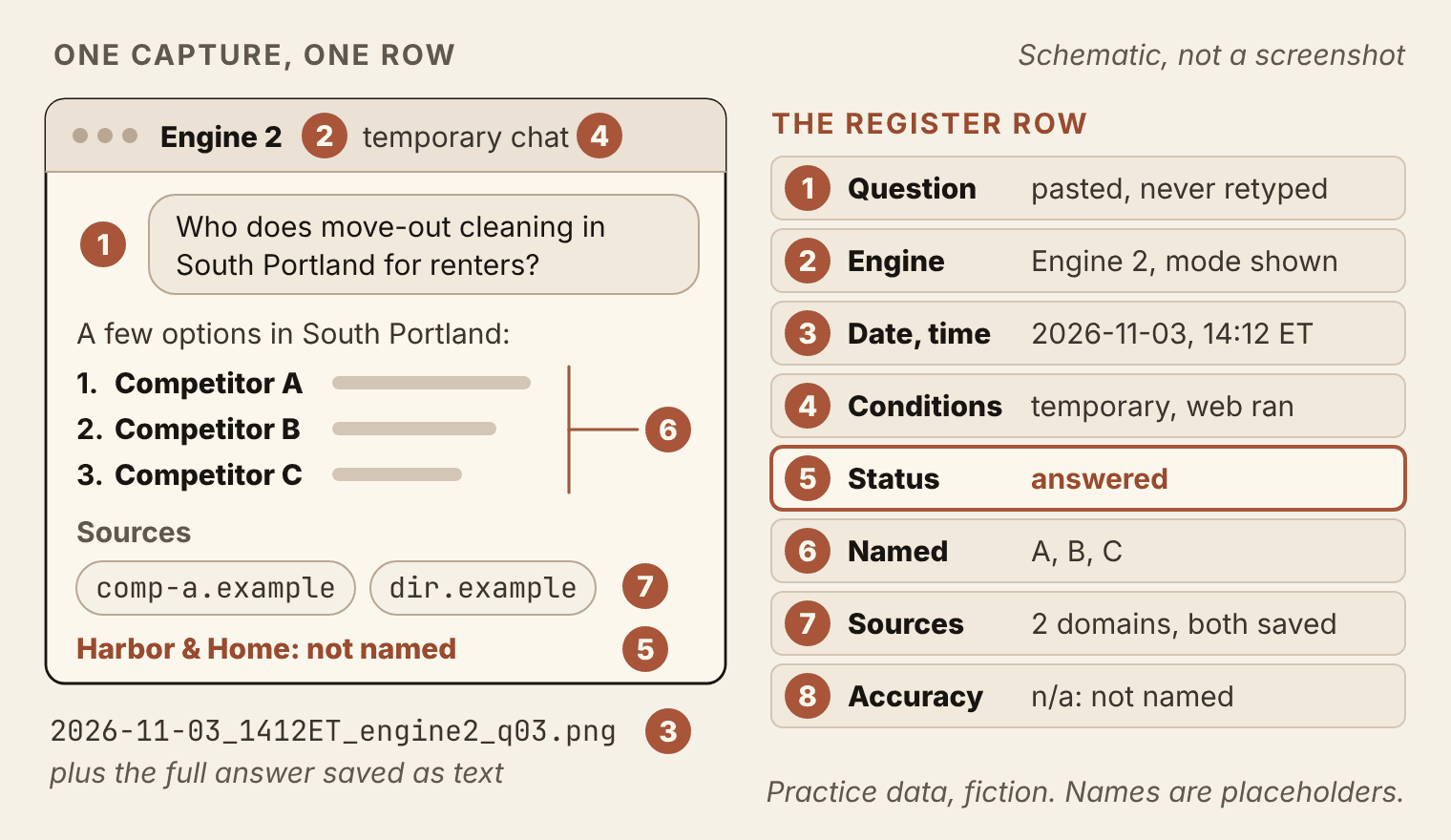
The row has eight fields: the exact question (pasted, never retyped), the engine with its mode or model, the date and time with the time zone, the session conditions, a status, the names the answer gave in order, the sources it showed, and an accuracy note saying whether what it said about you was true and what you checked it against.
The status field is where most homemade scans go wrong. Give it one of three values. Answered means the engine returned a real answer. Empty means it returned nothing, or a blank box, or an error dressed up as an answer. Blocked means the run never happened the way you asked it: a sign-in wall, a usage limit, a captcha. Only an answered row can count as a miss. Empty and blocked rows stay out of every total, and you rerun them in a fresh session later, with a note that you did. That is the rule from my thrown-out baseline, written into the spreadsheet.
One pass of ten questions across four engines gives you forty readings, and a reading is not yet a finding. Engines vary from run to run. My own floor for anything I report to a client is three runs per question per engine, and the reporting rhythm in chapter 13, The Report That Renews, builds toward that. For your first pass, one run of each is enough to learn the method and see the obvious gaps. Write "one run" on the scorecard so nobody reads it as more.
Screenshots need a little discipline too:
- Put the date and time in the filename (
2026-11-03_1412ET_engine2_q03.png), and keep the date visible in the capture when the screen shows one. - Save the full answer as text beside the image. A screenshot crops; the text file keeps the whole answer.
- Blur personal data, such as your name in the sidebar or a customer's details.
- Never edit an answer. Leave even the typos. If it's wrong, the wrongness is the finding.
Score it
Scoring is counting, and the counting rules are set before you look at a single answer.
Draw the grid: questions down the side, engines across the top, one cell per capture. Each cell gets one of five marks. Named: the answer mentioned you. Not named: a real answer that named somebody else. Answered, nobody named: a real answer that named no business, common on a question like "what does a deep clean include?" It counts as answered and not named, but it stays out of the competitor counts, because nobody beat you. Empty: an engine failure. Blocked: the run didn't happen as asked. Notice what the grid leaves out. There is no column for position, because an answer has none.
There is no slot seven. You are in the answer or you are not, and the engine decided that before the buyer finished typing.
Total each engine as a fraction, never a bare percentage: "named in 3 of 9 answered". Write the coverage beside it: "9 of 10 answered". A gap in coverage looks exactly like a gap in visibility once it becomes a chart. In my own published scan, one engine hit a usage limit and never ran seven of the questions, so its rate sat on a smaller set than the other engine's. A second table limited to the questions both engines answered narrowed the gap between them by about half. When anyone shows you a visibility percentage, yours included, ask for the top and bottom of the fraction.
Keep discovery and branded totals separate. Then read the same captures for who won and why.
Who got named instead, and how often. Count each competitor across the answers you lost. The business named most often is your real competitor in the engines, and it may not be the one you worry about.
Which pages were cited. Where an engine showed sources, list the domains. These are the pages doing the work: a directory, a review roundup, a competitor's service page, an old news story. They are the raw material of your fix list.
Check every answer that named you for truth, too. One that names you with the wrong price or an old address is not a win. Mark it named, then put it on the fix list anyway. In the practice set, question 6 is a trap worth keeping: Harbor & Home publishes deep-clean prices only up to 1,500 square feet, so an engine that states a firm price for 1,800 square feet has made one up. Score that as an accuracy problem, never as a price.
Before you score, write down what counts as your name. A misspelling the engine clearly meant counts; a different company with a similar name does not. Keep the alias list short and write it in the file.
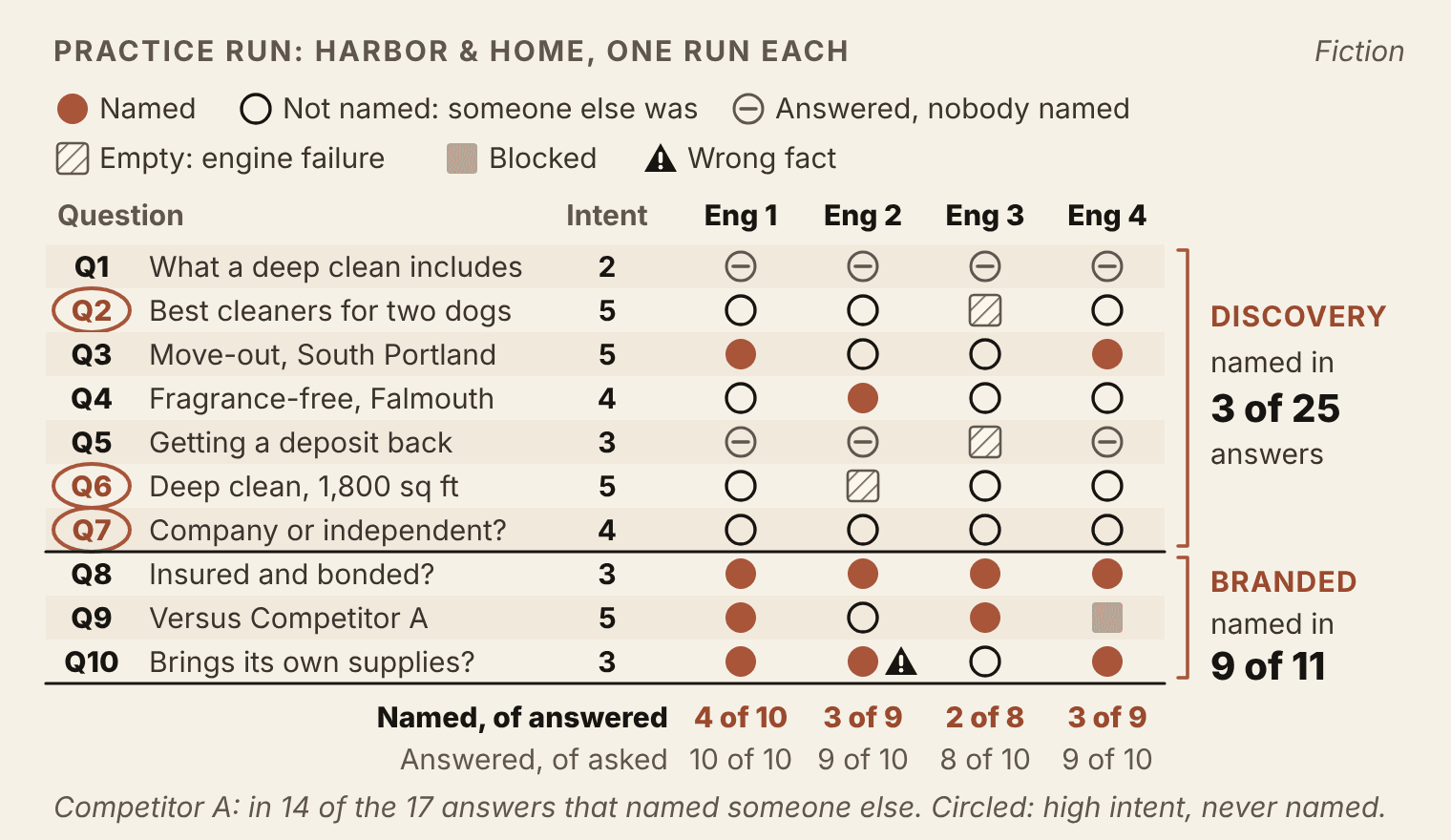
Sam's step. Sam ran Harbor & Home's ten questions on a Tuesday afternoon, the day after Dana's Monday numbers went out. Sam's first note to Dana said Harbor & Home showed up in 30 percent of AI answers: named in 12 of 40 runs. Two mistakes sat inside that one number. The three empty answers and the blocked run had gone into the "not named" pile, which made the company look worse than it was. And the branded and discovery questions were blended, which made it look better, because most of those twelve came from questions that already had Dana's company name in them. Sam pulled the four failed runs, wrote the coverage beside the total, and split the rest: named in 3 of 25 discovery answers and 9 of 11 branded. That is the grid in Figure 6.3. Dana read the second note and asked the right question: who are they naming instead?
The rest of the grid answers her. Questions 2, 6 and 7 are circled: high-intent money questions where no engine named Harbor & Home at all. Of the 24 answers that didn't name the company, 7 were general advice on questions 1 and 5 that named no business at all. The other 17 named somebody else, and Competitor A appears in 14 of them. And one named answer is flagged for accuracy, because it says clients must supply their own products, the opposite of Harbor & Home's policy.
Resist the score out of a hundred, even when asked. A single number starts an argument about the number. A grid with three circled questions starts a decision.
The fix list and your first sales asset
A finished scorecard tells you where you stand. The fix list decides what you do about it, and the order matters more than the length.
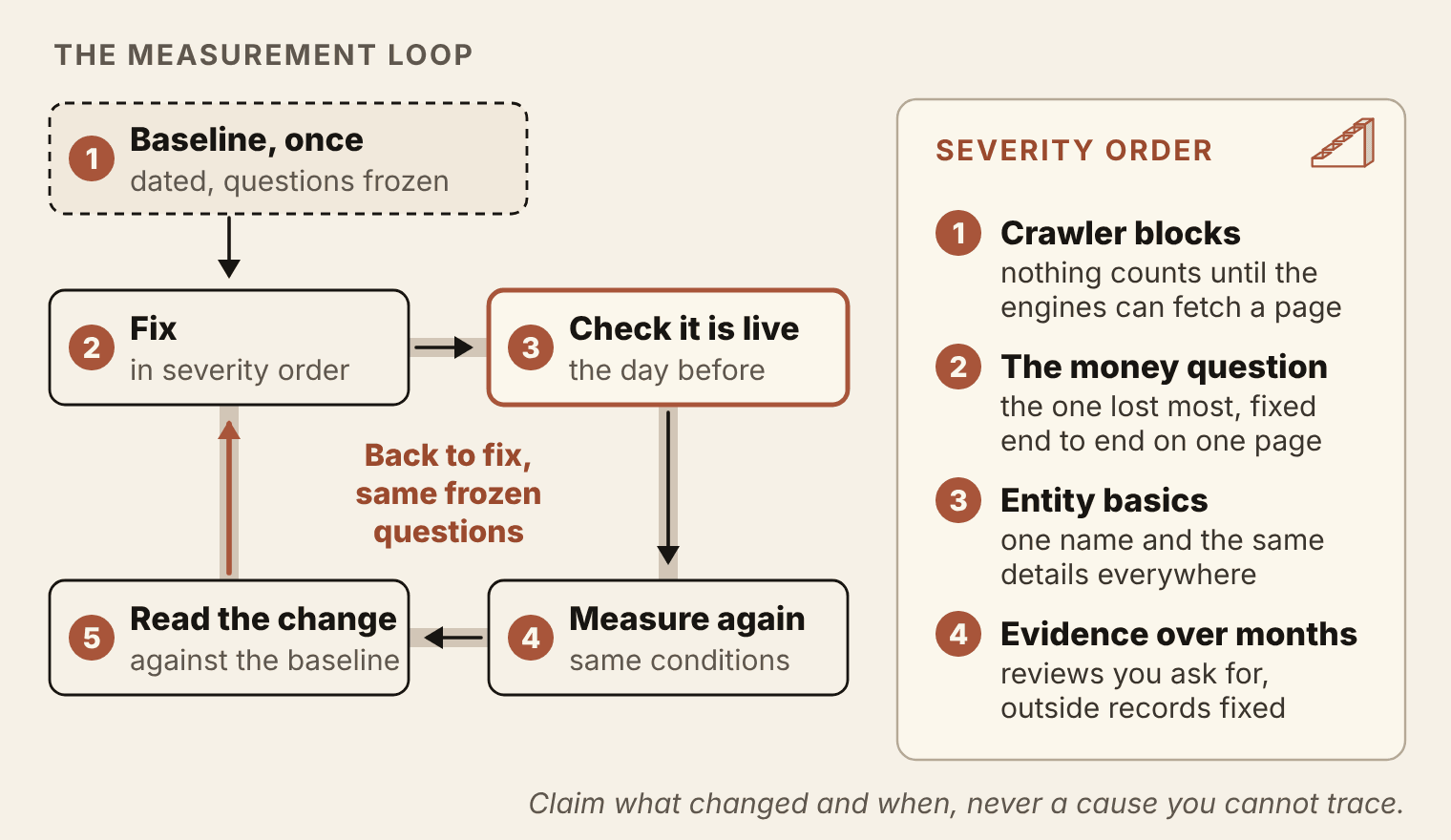
- Anything that stops a crawler reading you. Chapter 5's access check comes first, because nothing else counts until the engines can fetch the page.
- The single most-lost money question, fixed end to end on one page. Put the answer in the first paragraph, the facts in plain text, a short FAQ under question headings, and markup that matches what the page shows. One question fixed all the way teaches you more than ten questions touched.
- Entity basics. The same name, description, address and phone everywhere an engine looks: your site, your Google Business Profile, the directories, the old listing from your previous address.
- Evidence that builds over months. Reviews you ask customers for, and outside records you get corrected. Start the asks now, because these take the longest.
Each inaccurate answer gets its own line. Find the page the engine most likely drew on, correct it if it's yours, and request a correction where it isn't.
Then the loop: from a dated baseline, fix in severity order. The day before you measure again, spend five minutes confirming the fixes are actually live: view the page source on the production site and open the directory listing you corrected. Then run the frozen questions again under the conditions you recorded, and read the change against the baseline. Never claim a fix caused a change you can't trace; you can say what changed, and when.
I ship repairs the same day where I can, because the scan is only the diagnosis. A block of structured data or a corrected listing is small and checkable, and it gives the next reading something to show.
A scan that does not end in shipped repairs is a mood.
Now turn the method outward. Choose one business you would like as a client and run the same scan, with your ten questions rewritten for their trade and town. You are not writing them a report. You are looking for one picture: a discovery question about their exact customer in their own town, with a dated answer that names two of their competitors and not them.
Keep the clearest one, with its text file and register row. It is the attachment in chapter 8. A business owner can argue with a score or with your opinion of their website. A dated picture of a machine recommending a competitor to their customer this week is much harder to argue with.
Watch out. A screenshot that names competitors records what an engine said on one day. Keep it that way: date it and show it whole, without adding a word of your own about those businesses. Never publish a prospect's results, or name them as an example, without their written permission.
How I run it
The free assessment from Suede AI's search visibility practice is this chapter run for someone else. Their buyer questions go to the engines their buyers use, and every answer is captured with its date and a screenshot. Beside each gap sit the competitors who were named and the pages the engine cited. Paid work starts only after that, and the first thing it delivers is a repair. I keep the day-one captures on file beside the list of fixes I ship, so every later answer is read against where we started.
Two habits are worth copying exactly. Client captures run from sessions not connected to my accounts, so my history can't tilt their answers. When I scan my own company, the tool is signed into my accounts, so I label those numbers an upper bound. An engine that knows you is a friendlier judge.
Save this
Into library/playbooks/visibility-scan/:
prompts.md: the ten frozen questions, dated, each marked discovery or branded, with its intent score.register.csv: one row per capture, with the eight fields.scorecard.md: the grid, fractions with coverage, the competitors named instead, the cited domains and the circled questions.fix-list.md: the fixes in severity order, each with the date it shipped and the date you checked it was live.
Into library/scans/<business>/<date>/: the raw answers as text, the dated screenshots and the README naming the target. One folder per business, one subfolder per reading.
Built on
Book 3, chapter 14, The Night Shift, runs this scan on a schedule with a budget cap. Book 1, chapter 13, Ask About Yourself, is the first time you asked an engine what it knows about you. Book 2, chapter 7, Research With Receipts, taught you to read sources one at a time.
As of November 2026
Checked November 1 to 3, 2026. Menus move; if a name below has changed, look for the private or temporary chat option in the product's own help pages.
- ChatGPT searches the web when a question needs current information and puts links in the answer, with a list of sources behind a Sources button or the More actions menu. Temporary Chat stays out of your history and memory and is not used for training; personalization carries into it only if you opt in when you start one.
- Claude searches the web on every plan, including Free, when it judges the question needs it, and cites its sources (on Team and Enterprise plans an owner turns search on first). If the "+" menu shows a Web search switch, as it does in an incognito chat, turn it on. Incognito chats (the ghost icon) stay out of your history and memory and are never used for training, but Anthropic keeps them for 30 days before deleting them, and your profile preferences still apply. You can also turn memory off for a single chat from the "+" menu before the first message.
- Gemini, signed in with a personal Google Account, offers a Temporary Chat from the icon beside New chat. It stays out of your recent chats and is not used to personalize your experience; Google keeps it for up to 72 hours.
- Perplexity shows numbered sources with its answers. Signed-out threads are anonymous and expire after 14 days. Signed in, an incognito thread is hidden from the sidebar but still listed on your History page until it expires after 24 hours, so a signed-out session is the cleaner choice for a scan.
Landing
You can now:
- 5.6 Run ten buyer questions across four engines for one business and capture the evidence.
- Freeze a question set, score a grid that keeps engine failures out of every total, and order a fix list by severity.
Carry forward: library/playbooks/visibility-scan/, your own dated baseline, and one screenshot of a prospect's gap.
Next: Chapter 7, Receipts Sell. You publish your own scan, losses included, on a page a stranger can check in a minute, so the screenshot you send in chapter 8 points at something real.
Book 5 of 5 · Chapter 6 of 15