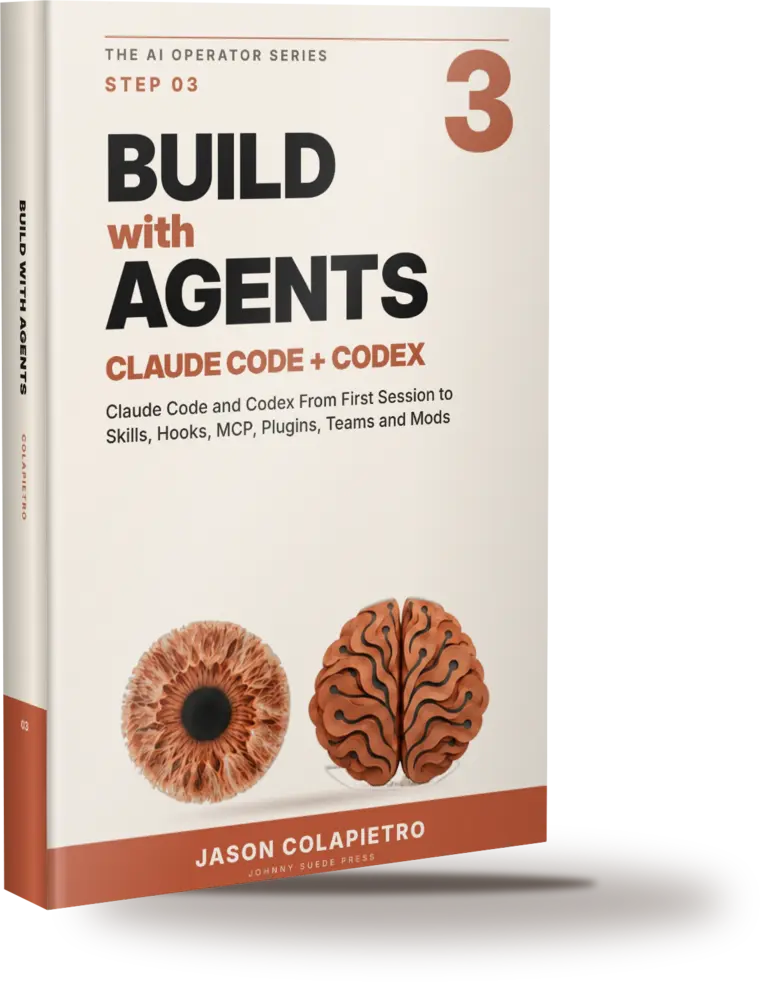
STEP 03 of 05 · The AI Operator Series
Build With Agents
Claude Code and Codex From First Session to Skills, Hooks, MCP, Plugins, Teams and Mods
Run coding agents like a team lead: brief them, fence them in, check their work, then extend them with your own skills and plugins.
The reader
Who is Build With Agents for?
Builders who want software shipped: developers, technical founders, and operators opening a terminal for the first time to put an agent to work.
By the last page
What will you be able to do after this book?
- Install Claude Code and Codex, plan before an agent touches anything, and read the diff before you accept a line of it.
- Keep one AGENTS.md rules file that both agents read, and turn every mistake into a rule you can check.
- Write one skill folder that serves Claude Code and Codex, and wire hooks that run checks on every edit.
- Connect an MCP server, treat tool output as data, and catch a planted prompt injection before it acts.
- Run parallel agents in separate worktrees, ship a plugin, and run a crew with a lead, a worker and a verifier that checks done against the live result.
16 chapters, in order
What is inside Build With Agents?
Chapter 1: Staffing, Not Software
An agent is a reasoning layer, tools, memory and guardrails working inside limits you set. Meet Claude Code and Codex, choose where to run each, ask a read-only first question and write the first agent job as a seven-field brief.
Chapter 2: The Terminal, Plainly
Folders, the terminal, git and GitHub in plain words for Mac, Windows and Linux. Install both agents, add a .gitignore that keeps secrets and chat exports out, and push library/ to a private GitHub repo.
Chapter 3: Plan Before It Touches Anything
Permission modes, allow, ask and deny rules in order, the sandbox, and Codex's sandbox and approval presets. The first real session is a plan-mode audit of the Harbor & Home practice files that changes nothing and ends in a report.
Chapter 4: Read the Diff, Use the Rewind
Read the diff before believing the agent's summary, rewind an edit nobody asked for, and commit only the wanted change. The chapter maps three kinds of undo (checkpoint, worktree, commit) and what each cannot restore.
Chapter 5: The Rules File
One AGENTS.md that both agents read (CLAUDE.md imports it), seeded from the Volume 2 Project instructions. Each mistake becomes a checkable rule that says where it stops applying, and a cold-agent test in the other tool proves the file works.
Chapter 6: Meters, Models and the Handoff
The context meter and compaction, model and effort chosen by what a mistake would cost, a week of usage readings, and an eight-field handoff note that a fresh session resumes from in minutes.
How an agent loads a skill in three steps, a short description that names the job and the moment to use it, and a complete SKILL.md built from your best saved prompt with five pass-or-fail checks. One skill folder serves both Claude Code and Codex, and a trigger test proves the skill refuses near misses.
Chapter 8: Make "Whenever" Automatic
Sort each rule into a fact or a whenever. Capture a real hook payload with a probe first, then add a guard that blocks edits to facts.md, a formatter after edits and a log line on every commit, all as cross-platform Python scripts.
Chapter 9: Give the Agent Reach
Decide whether a gap needs a server, a skill or a hook, then connect one MCP server at project scope (GitHub as the example). Tool output is data, never orders: catch a planted prompt injection, then sketch a five-tool booking server that passes the pair test.
Chapter 10: A Second Context Window
When a subagent pays and when it does not. Write a read-only reviewer whose brief carries every decision, delegate one review, and check one finding and one pass before trusting the report.
Chapter 11: Pack It, Share It, Mod It
Bundle the skills, hooks and reviewer into a harbor-ops plugin, publish it in a personal marketplace, install it in a fresh folder and score it with eval cases. Covers a five-point trust check for outside plugins and ends with a status line or one dated mod.
Chapter 12: Many Agents, One Repo
Fetch and measure before every task, give each task its own worktree cut from origin/main and each area one owner, run two lanes in parallel, merge both through pull requests, and remove worktrees safely.
Chapter 13: The Crew
Jason's five-layer agent stack mapped onto Harbor & Home, with the human as director. The edge test, critical path and an Amdahl check decide whether a crew beats one agent; then a lead, worker and fresh-context verifier run the Monday report, and you weigh the crew's cost against its result.
Chapter 14: The Night Shift
Headless runs (claude -p, codex exec) with a spending cap set before the run and the result read after, a scheduler chosen by where the job must run, and outward actions that never retry on their own. The project is a weekly AI visibility scan: locked questions, raw answers saved to disk, append-only results, and a loud stop on any empty answer. It feeds the free diagnostic in Volume 5.
Chapter 15: Done Means Live
A green check proves only the same thing, in the same place, doing the same action. Check an agent's done against the live result, keep dated evidence, log an incident and promote its rule into AGENTS.md or a hook.
Chapter 16: The Weekly Agent Review
Jason's sixty-minute weekly review in four fifteen-minute blocks, rebuilt for agents: what ran, drift, what is about to change, and decisions. Then the Twenty-Year Test on the whole setup and the Volume 1 ownership test aimed at the repo, with the hand-off to Volume 4.
Table of contents for the first printing.
From Stake Your Claim
You don’t leave slogans. You leave systems. Systems that keep working when you’re not in the room.
Free sample
Read Chapter 7: From Keeper to Skill
Turn your best saved prompt into a skill Claude Code and Codex both load on their own, and prove it says no. About 25 min. The book continues with Chapter 8, Make "Whenever" Automatic.
Delivered by the author
Reserve Volume 3
Reserve Volume 3: Build With Agents now and your copy is first in line when it prints. Pick this volume or the whole series in the form.
- Jason Colapietro delivers every copy personally.
- Reservations are first in line when each volume prints.
- No payment today. You confirm when your copy is ready.
Questions
About Volume 3
Do I need to know how to code to read Volume 3?
No. You need to be willing to open a terminal. Chapter 2 explains folders, the terminal, git and GitHub in plain words for Mac, Windows and Linux and installs both agents, and Chapter 4 teaches you to read a diff before you believe the agent's summary.
Does Volume 3 cover both Claude Code and Codex?
Yes. Volume 3 runs Claude Code and Codex side by side: one AGENTS.md rules file both agents read, one skill folder that serves both, and headless runs in each. Hooks, MCP, plugins and agent teams get chapters of their own.
What is in the free sample?
The free sample is Chapter 7, From Keeper to Skill: how an agent decides to load a skill, a description that names the job and what the skill is not for, and a complete SKILL.md built from your best saved prompt, with a trigger test that proves the skill says no to near misses.
How is Volume 3 different from The Claude Code Bible?
The Claude Code Bible is a deep operator reference for Claude Code. Volume 3 is a progression across Claude Code and Codex, written for readers coming up from Volumes 1 and 2, with new exercises at every step.
How do I get a copy of Volume 3?
Reserve a copy on this page. Jason Colapietro delivers every copy personally. Reservations are first in line when Volume 3 prints.