STEP 04 of 05 · The AI Operator Series
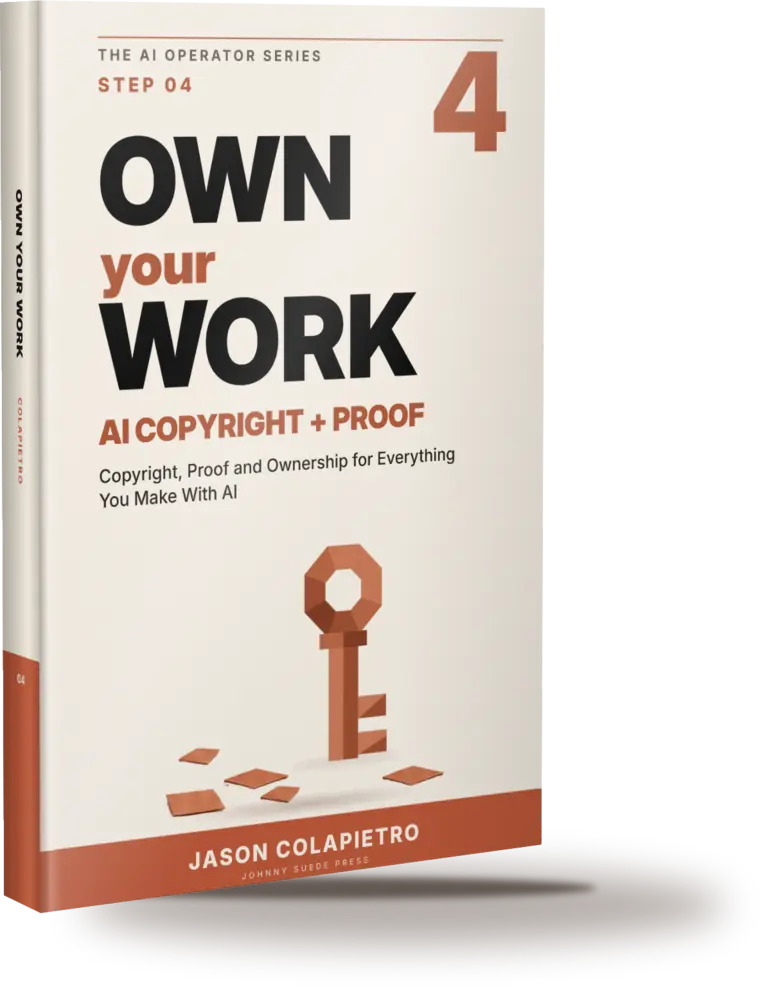
Own Your Work
Copyright, Proof and Ownership for Everything You Make With AI
Keep what you make with AI yours, with a record of creation that a buyer, partner or platform can check.
The reader
Who is Own Your Work for?
Creators, founders and professionals whose voice, catalog, data or ideas are the asset, and who now produce part of that work with AI.
By the last page
What will you be able to do after this book?
- Put every project under a dated record as you work: version history, an AI-use ledger, exported originals and a fingerprint with an outside timestamp.
- Read each AI tool's terms once for five ownership questions, and keep a dated terms card for every tool you rely on.
- Replace claims with receipts: a public page of dated items a stranger can check, and a disclosure line for your work.
- Treat your voice and likeness as owned assets, with consent records and a one-page policy for anything that speaks in your name.
- Set your terms once, export and back up every account, and leave a one-afternoon estate plan for your AI life.
14 chapters, in order
What is inside Own Your Work?
Chapter 1: The Bargain You Signed
The platform bargain applied to every AI tool you rely on: list each tool and account, what it holds of yours, whether you keep a copy or only rent access, and the one dependency that would hurt most.
Chapter 2: Read the Terms You Clicked
Read each tool's terms once for five ownership questions (inputs, outputs, training, retention, business plans), set the controls on purpose, and keep a dated terms card for every tool.
Chapter 3: What You Own When AI Helps
Copyright follows human authorship: how the US Copyright Office treats AI-generated material, what employers, clients and collaborators can claim, the Bartz fair-use counterpoint, and a label with evidence for every piece of your work.
Capture beats reconstruction. Put one real project under a dated record in twenty minutes: version history, a four-part AI-use ledger, exported originals, and a SHA-256 fingerprint with an outside timestamp, each with what it proves and what it does not.
Chapter 5: Receipts, Not Claims
Replace self-description with things a stranger can check: an evidence room, a public receipts page with five dated items, an identity check before your agents post, and one receipt that captures itself.
Chapter 6: The Authenticity Premium
Why verifiable human work holds its price as synthetic supply grows, told with Jason's diamond and cubic zirconia, and why disclosure is part of the proof. Write the disclosure line you will use.
Chapter 7: Your Voice and Likeness
Voice and likeness can be copied in minutes and the law differs by state. Treat your voice spec as an owned asset, keep consent records, ask four questions before anything speaks in your name, and write a one-page policy.
Chapter 8: Your Data, Exported and Backed Up
Map where your data lives across ChatGPT, Claude, Claude Code, Codex and your repos, export every account on a schedule, keep two backups you control with a tested restore, and give every data set an owner.
Chapter 9: Set Your Terms Once
Pre-make the decisions about your work, license your library, set your site's crawler rules by bot role (for example allow search, block training), and publish terms that people and machines can read.
Chapter 10: Contracts That Move Ownership
The clauses that quietly move ownership (delivery instead of payment, a deleted credit line, one-sided indemnity, the lost deposit), model terms for AI services where the client keeps data and keys and the method stays licensed, and a redline with questions for a lawyer.
Chapter 11: Your Name Is the Index
Make credit compound to a person: a handle audit, one canonical page, valid Person JSON-LD with sameAs links, and agents that publish under your name.
Chapter 12: Sovereignty, Not Tenancy
Jason's three abilities (prove it, set its terms, transfer it) turned into a score for your setup, his regulatory forecast kept separate from current law, and one dependency moved to an open format such as Markdown, AGENTS.md or Agent Skills.
Chapter 13: Your Balance Sheet
Put everything the series built on one page as assets, liabilities and dependencies, run the Volume 1 ownership test on every line, answer Jason's valuation question, and schedule a quarterly ownership audit.
Chapter 14: The Estate Plan for an AI Life
Jason's minimum viable estate plan widened to every AI-era account: password-manager emergency access, an account inventory of pointers with no secrets, a named digital executor, a letter of intent, and an attorney review in one afternoon.
Table of contents for the first printing.
From Stake Your Claim
The people who will be protected are not the most talented. They are the people who establish provenance early.
Free sample
Read Chapter 4: Proof at the Point of Capture
Put one real project under a dated record in twenty minutes, so the answer to who made it is a folder, not a story. About 23 min. The book continues with Chapter 5, Receipts, Not Claims.
Delivered by the author
Reserve Volume 4
Reserve Volume 4: Own Your Work now and your copy is first in line when it prints. Pick this volume or the whole series in the form.
- Jason Colapietro delivers every copy personally.
- Reservations are first in line when each volume prints.
- No payment today. You confirm when your copy is ready.
Questions
About Volume 4
Who is Volume 4 for?
Anyone whose work is the asset: musicians, writers, designers, consultants and founders. If you publish, sell or license what you make, Volume 4 shows you how to prove it is yours, and readers who start here get a no-code path through every chapter.
How does Volume 4 work with my attorney?
Volume 4 gives you the records, checklists and questions to bring to an attorney, so the hour you pay for goes further. Chapter 10 ends with a redline and a list of questions for your lawyer, and Chapter 14 closes with an attorney review of your estate plan.
What is in the free sample?
The free sample is Chapter 4, Proof at the Point of Capture: put one real project under a dated record in twenty minutes with version history, an AI-use ledger, exported originals and a SHA-256 fingerprint with an outside timestamp, and learn what each one proves.
How do I get a copy of Volume 4?
Reserve a copy on this page. Jason Colapietro delivers every copy personally. Reservations are first in line when Volume 4 prints.